
India's Solar Push Idles Factories Unable to Shake Reliance on China
A Reuters report reveals that India's drive to build its own solar manufacturing capacity has left many factories idle because they still depend on Chinese components and technology.
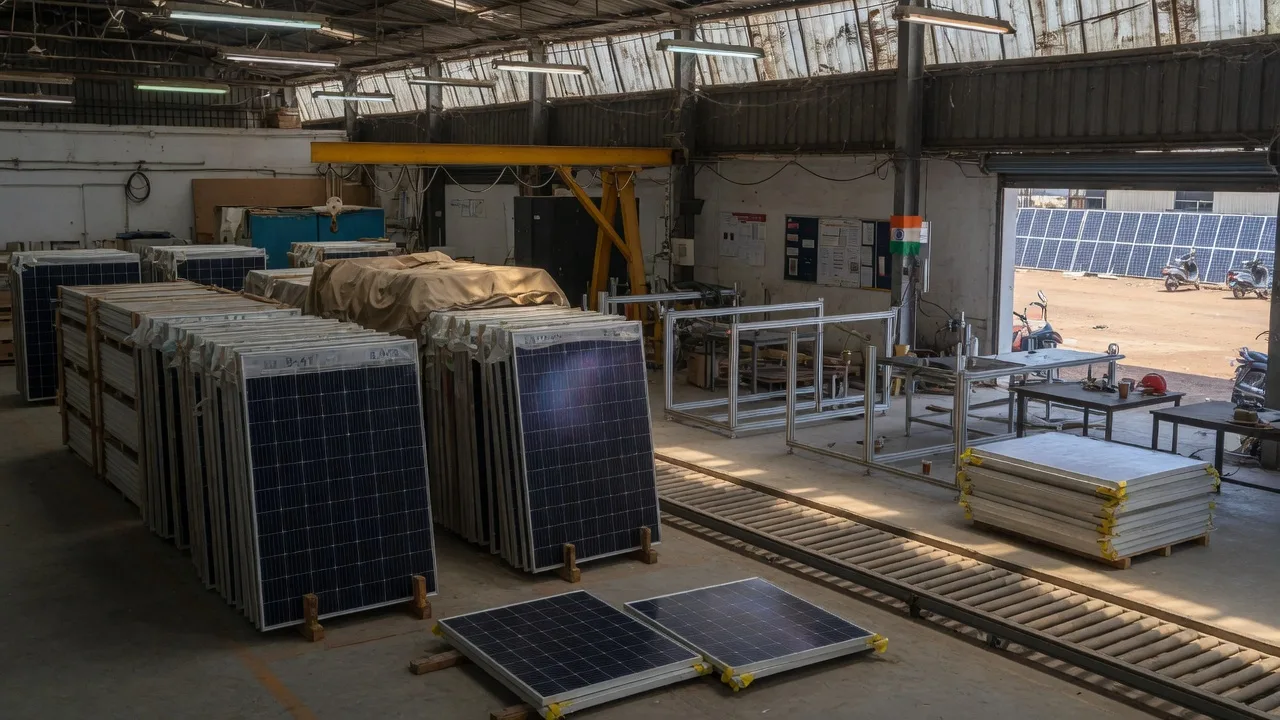
India wants to become a solar powerhouse. But a Reuters investigation shows that its push to build domestic solar panel factories has backfired. Many of those factories now sit idle.
The problem is China. Indian manufacturers still rely on Chinese-made cells, wafers, and machinery. Without them, they cannot produce panels cheaply enough to compete. So plants that were meant to cut India's dependence on Beijing are instead shutting down.
India has set a target of 500 gigawatts of renewable energy capacity by 2030. Solar is meant to be the backbone of that plan. The government has offered billions of dollars in subsidies and put up trade barriers to encourage local production. But the strategy has hit a wall.
Factories built, then stopped
Reuters spoke to industry executives and reviewed government data. The picture is stark. Of India's total solar cell and module manufacturing capacity, a large chunk is not running at full capacity. Some factories have not started production at all.
The main reason: Indian companies cannot get the raw materials they need. High-quality solar cells and wafers come almost entirely from China. Indian firms tried to make their own, but they found it too costly and technically difficult. So they buy Chinese cells and assemble them into panels. But government schemes demand that they use Indian-made cells to get subsidies. Caught between rules and reality, many factories have stopped.
"We built the plant, but we can't run it," one industry executive told Reuters. "The economics don't work."
China's grip on the supply chain
China dominates every step of the solar supply chain. It makes more than 80% of the world's solar cells and 90% of its wafers. Indian companies cannot match Chinese prices. Even with tariffs on Chinese imports, Indian panels cost more.
The government tried to fix this. In 2022, it imposed a 40% duty on solar module imports and a 25% duty on solar cells. It also launched a production-linked incentive scheme worth about $2.5 billion. But the policy backfired. Domestic manufacturers could not get enough Indian-made cells, so they could not make panels. Some shifted to importing cells and paying the duty, but that made their panels too expensive for buyers.
Solar project developers, who build large solar farms, are caught too. They need cheap panels to win bids. Indian panels are often 10-15% costlier than Chinese ones. So developers push for imports, or delay projects. That slows India's renewable energy goals.
Idle capacity, lost jobs
The idled factories mean lost jobs and wasted investment. Reuters estimates that India's solar module capacity is over 50 gigawatts per year, but actual production is far lower. Many factories run at less than 30% capacity. Some have never made a single panel.
Smaller companies have been hit hardest. They lack the cash to stockpile Chinese cells or invest in backward integration. Larger players like Adani and Tata Power have more room to absorb costs, but even they struggle.
The government is now considering tweaking its rules. It may allow more Chinese cell imports for a limited time, or offer more subsidies for domestic cell production. But no final decision has been made.
"We need a realistic policy," said another executive. "You can't just ban imports and expect factories to run."
Comments
Be the first to comment.
Leave a comment