Indo-German EV Supply Chain Cooperation: A CSEP Case Study
A new CSEP report argues that India and Germany can build stronger electric vehicle supply chains together, reducing reliance on China.
NEW DELHI, India wants to build its own electric vehicle supply chains. Germany wants to diversify its sources. A new report from the Centre for Social and Economic Progress (CSEP) says the two countries can help each other.
The study, titled "Building India's Electric Vehicle Supply Chains: A Case for Indo-German Cooperation," looks at where India stands today and what it needs to grow. It points to a simple fact: both nations share a goal of cutting dependence on China for critical EV materials and components.
India has raw materials. It has lithium reserves in Jammu and Kashmir, though commercial extraction has not started. It also has rare earth deposits. But the country lacks the processing plants and battery cell factories that turn those minerals into finished parts.
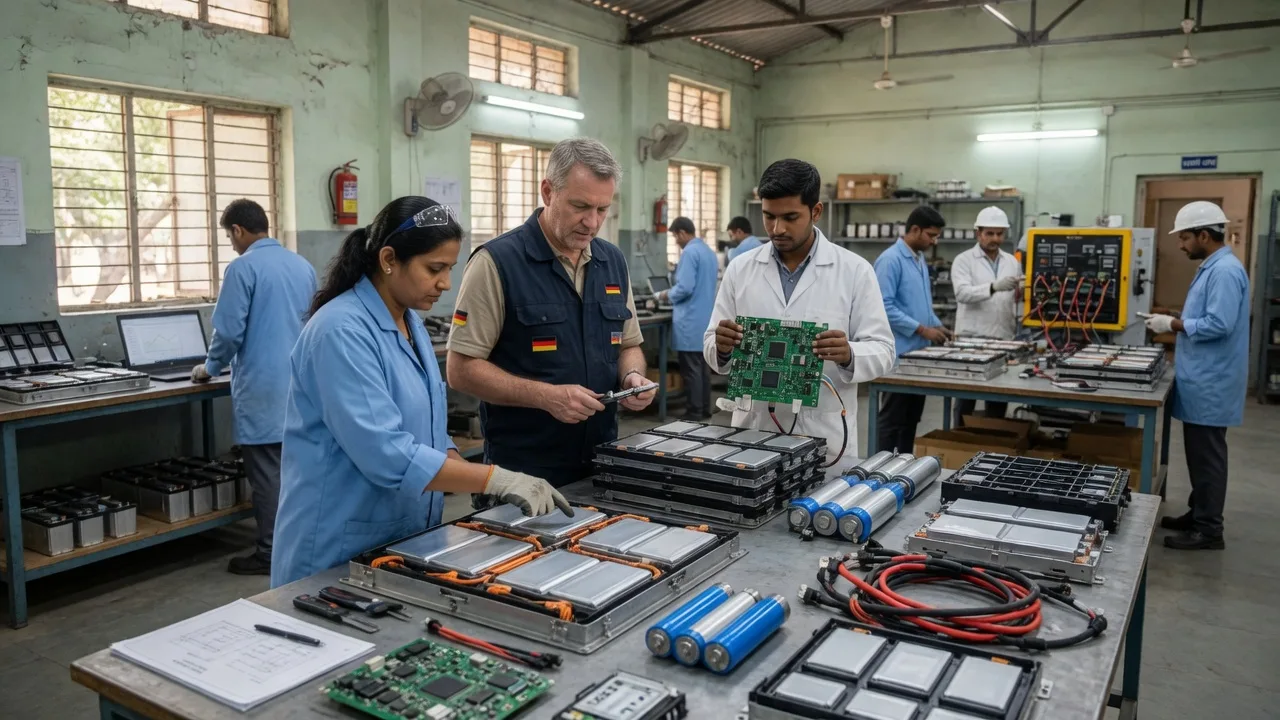
Germany, by contrast, has advanced manufacturing know-how and a strong automotive sector. German carmakers are already shifting to electric models. They need batteries, motors, and electronics, and they need supply lines that are secure.
The CSEP report argues that joint ventures between Indian and German firms could fill the gaps. Indian companies could supply processed minerals and battery components. German firms could bring technology and capital. Together, they could build gigafactories in India to make battery cells, modules, and packs.
"The current EV supply chain is heavily concentrated in China," the report notes. "Both India and Germany have strategic reasons to build alternative routes."
The report also flags hurdles. India's battery recycling industry is small. Its charging infrastructure is patchy. And policy support for EV manufacturing has shifted over time, creating uncertainty for investors.
On the German side, companies worry about India's import duties on EV parts and its complex tax system. They also want clearer rules on data localization and intellectual property.
Still, the report says the opportunity is real. India's EV market is growing fast. Sales of electric two-wheelers and three-wheelers are rising sharply. Electric car sales, though still low, are picking up. The government has set a target of 30% EV penetration by 2030.
Germany, through its development bank KfW and agencies like GIZ, already runs clean energy programs in India. The report suggests expanding those partnerships to cover EV supply chains. It calls for a bilateral task force to identify projects and remove bottlenecks.
The study also recommends that India speed up its production-linked incentive (PLI) scheme for advanced chemistry cell batteries. So far, the scheme has attracted bids from companies like Reliance, Ola, and Rajesh Exports. But none of the planned factories are producing cells yet.
For Germany, the report says, investing in India is not just about sourcing. It is also about selling. India's EV market could become a big buyer of German-made charging equipment, testing gear, and automation systems.
The CSEP paper ends with a concrete proposal: start with one or two pilot projects, a battery recycling plant in Gujarat, a lithium processing unit in Karnataka, and scale up from there. "Small steps can build trust," it says. "Trust can build supply chains."
Comments
Be the first to comment.
Leave a comment