
Tata Motors' EV Sales Surge 68% in Q3 2024: Can Nexon EV Hold Off Hyundai and Mahindra?
Tata Motors sold 19,000 electric cars in the third quarter of 2024, but rivals Hyundai and Mahindra are closing in with new models and aggressive pricing.
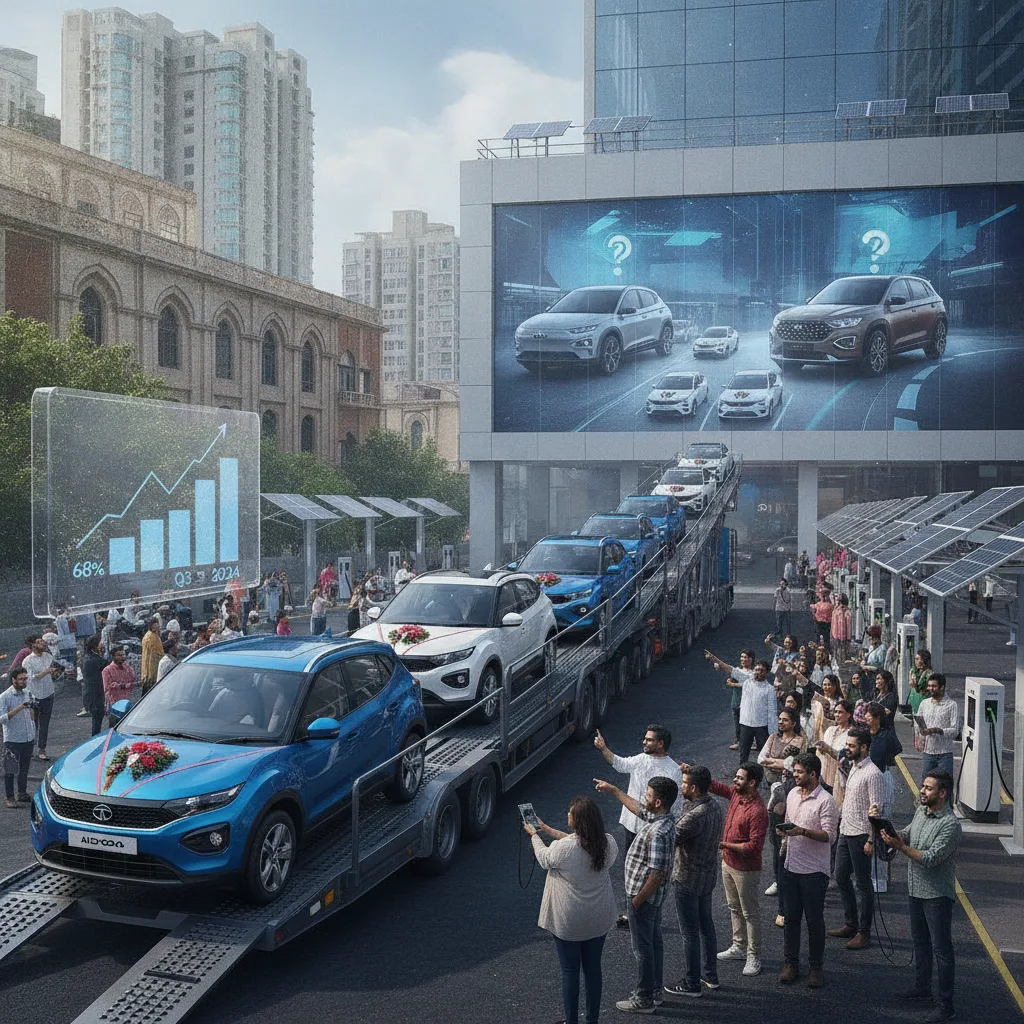
Tata Motors sold 19,000 electric cars in the third quarter of 2024. That is a 68% jump over the same period last year. The Nexon EV alone accounted for nearly half those sales. But the question hanging over the company is simple: how long can it keep that lead?
Hyundai and Mahindra are not standing still. Hyundai launched the updated Kona Electric in October, priced at ₹24 lakh. Mahindra rolled out the XUV400 in September, starting at ₹15.9 lakh. Both cars go head-to-head with the Nexon EV, which starts at ₹14.5 lakh.
Numbers tell a clear story
Tata's total EV sales in Q3 2024 hit 19,003 units. That compares with 11,334 in Q3 2023. The Nexon EV sold 9,400 units. The Tiago EV, Tata's entry-level model, sold 5,200. The Tigor EV added 2,800. The remaining 1,600 came from the newly launched Punch EV and the older XPRES-T fleet model.
Hyundai sold 4,800 electric cars in the same quarter. That is up 22% from 3,930 a year ago. The Ioniq 5 and the new Kona each did around 2,400 units. Mahindra sold 3,100 XUV400s, a 40% jump from 2,200 in Q3 2023. MG Motor India sold 2,400 ZS EVs, flat compared with last year.
Tata still holds 62% of India's passenger EV market. Hyundai has 16%, Mahindra 10%, and MG 8%. The rest is split between BYD, Citroën, and BMW.
Why Tata is winning
Three things drive Tata's lead. First, price. The Nexon EV undercuts the Kona by nearly ₹10 lakh. Second, range. The Nexon EV Max claims 465 km on a single charge, more than the XUV400's 375 km and the Kona's 452 km. Third, service network. Tata has 1,200 service points across India. Hyundai has 1,100. Mahindra has 800.
"Tata got to market early with a good product at the right price," said Ravi Bhatia, an auto analyst at JATO Dynamics in Mumbai. "But the gap is shrinking. Hyundai and Mahindra are catching up on range and features."
The Nexon EV also benefits from Tata's wider EV lineup. Buyers who walk into a showroom for a Tiago EV often walk out with a Nexon. That cross-selling does not happen at Hyundai or Mahindra, where EV options are thinner.
Rivals fight back
Hyundai is pushing hard on charging. It has 350 fast-charging stations across India. Tata has 1,000 slow chargers but only 150 fast ones. "Fast charging is a deal-breaker for many buyers," said Ankush Gupta, a Delhi-based EV buyer who picked the Kona over the Nexon. "I drive 80 km a day. I need a charger that works in 30 minutes, not six hours."
Mahindra is betting on the XUV400's bigger boot, 378 litres versus the Nexon's 350, and a claimed 0-100 km/h time of 8.3 seconds, faster than the Nexon's 9.0 seconds. Mahindra also plans to launch the electric XUV700 in early 2025, which could pull buyers from Tata's higher end.
Tata is not sitting still. It launched the Punch EV in November, priced at ₹12 lakh. Early data shows 1,200 units sold in its first month. The company also says it will add 200 fast chargers by March 2025. And the Nexon EV is due a facelift in early 2025, with a bigger battery and a new infotainment system.
"Tata has the momentum, but momentum can shift fast in this market," said Bhatia. "The next 12 months will tell us whether the Nexon EV becomes India's Model T or just another early winner that got overtaken."
Comments
Be the first to comment.
Leave a comment