
Agrivoltaics: A Way to Solve India’s Solar Land Crunch, Says TERI
A new report from The Energy and Resources Institute shows how growing crops under solar panels can help India scale up renewable energy without eating into farmland.
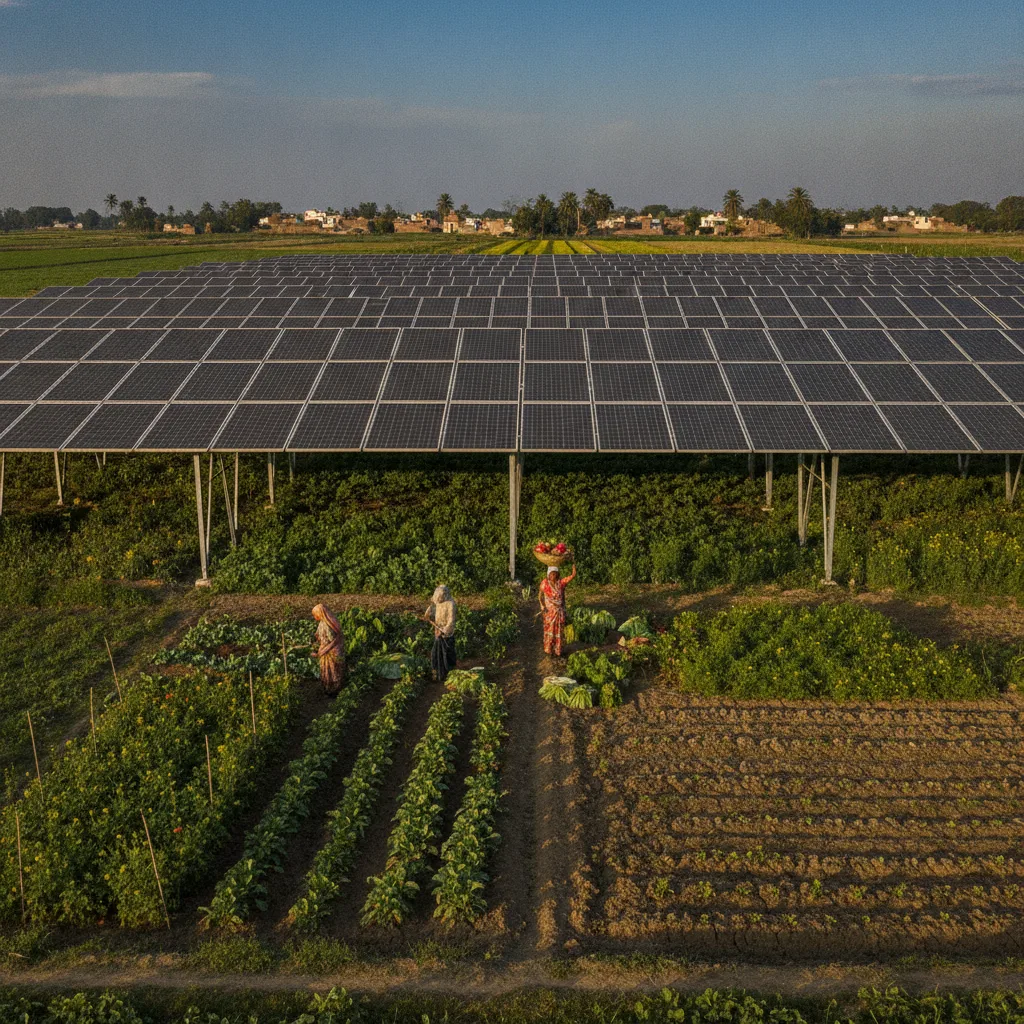
India wants 500 GW of clean energy by 2030. Solar will do most of the heavy lifting. But there is a problem: land. Big solar farms need huge tracts of flat, sunny ground. Much of that land is already used for farming. A new report from The Energy and Resources Institute (TERI) says agrivoltaics can square that circle.
What agrivoltaics means
Agrivoltaics puts solar panels above crops. The panels sit high enough for farmers to work underneath. They get shade and cooler soil. The panels produce electricity. Both the land and the sun earn their keep.
TERI ran field trials across India. In Gujarat, they tested crops like cotton and wheat under panels. Yields stayed stable. In some cases, they went up. The shade cut water loss from the soil. Farmers used less irrigation. That matters in a country where groundwater is running dry.
Land is the bottleneck
India has set aside 50,000 square kilometers for solar parks. Most of that is in arid or semi-arid zones. But even there, land is contested. Farmers resist selling. Communities push back. Agrivoltaics offers a way to avoid that fight. The same field grows food and makes power.
TERI's report points to a bigger win. India has 140 million hectares of farmland. If just 1% of that switched to agrivoltaics, it would add roughly 100 GW of solar capacity. That is a fifth of the 2030 target. The land stays in farmers' hands. They get a second income from selling electricity.
What the numbers say
TERI tested a 1 MW agrivoltaic plant in Rajasthan. It generated 1.5 million units in its first year. That matches a normal ground-mounted plant. But the land below grew mustard and chickpeas. The farmer earned ₹80,000 extra per hectare from the power. The crop income stayed the same.
The report also looked at costs. Agrivoltaics is more expensive to build. The structures are taller and sturdier. Installation runs 15, 20% higher than a standard solar farm. But TERI says the extra income from farming closes the gap within five years. After that, it is pure profit.
Policy needs to catch up
India has no national agrivoltaics policy. A few states have started pilot programs. Gujarat offers a 30% capital subsidy for agrivoltaic projects. Rajasthan is drafting rules. But most banks still treat agrivoltaics as high risk. They do not know how to value the dual revenue stream.
TERI recommends a clear definition of agrivoltaics in law. That would unlock bank loans. It also wants a separate tariff for agrivoltaic power. That would make projects bankable. The report calls for a national mission, like the one for solar parks.
The farmer's view
TERI interviewed farmers in Maharashtra who had tried agrivoltaics. They liked the shade. It kept their vegetables crisp and reduced sunburn on chilies. They worried about the panels blocking rain. But the design let water drip through the gaps. Soil moisture stayed higher than in open fields.
Farmers also said the extra income helped them buy better seeds and fertilizer. Some used the money to drill a borewell. The power from the panels ran the pump. That cut their diesel bill to zero.
What comes next
TERI is building a 5 MW agrivoltaic plant in Madhya Pradesh. It will grow soybeans and wheat. The data from that plant will feed into a national database. The goal is to give investors and policymakers hard numbers. Without those numbers, agrivoltaics will stay a niche idea.
India added 15 GW of solar last year. It needs to add 40 GW a year from now on. That pace will eat up land fast. Agrivoltaics is not a silver bullet. But it is a tool that lets India build solar without pushing farmers off their fields. TERI's report makes that case with data, not hope.
Comments
Be the first to comment.
Leave a comment