Can India and Europe make solar power without China?
A new DW analysis asks whether India and Europe can build solar supply chains that bypass China, the world's dominant producer of panels and polysilicon.
NEW DELHI, China makes roughly 80% of the world's solar panels. It controls even more of the supply chain upstream, from polysilicon to wafers to cells. That leaves India and Europe asking a hard question: Can they build solar energy without China?
DW.com looked at the numbers. The answer is not simple.
China's grip on solar
China's solar industry grew fast on state backing, cheap power, and scale. Today, Chinese firms supply about 97% of the world's silicon wafers and 80% of all solar cells. Europe, once a leader in solar manufacturing, now makes less than 3% of global panels. India's domestic production covers only a fraction of its needs.
Both regions have set big goals. India wants 500 GW of renewable energy by 2030. Europe aims to hit 1 TW of solar by 2030 under its REPowerEU plan. Meeting those targets without Chinese hardware looks tough.
India's push for self-reliance
India has tried to build its own solar industry. In 2022, the government slapped a 40% duty on imported solar modules and a 25% duty on cells. It also launched the Production-Linked Incentive (PLI) scheme, offering 24,000 crore rupees ($2.9 billion) to firms that make solar panels locally.
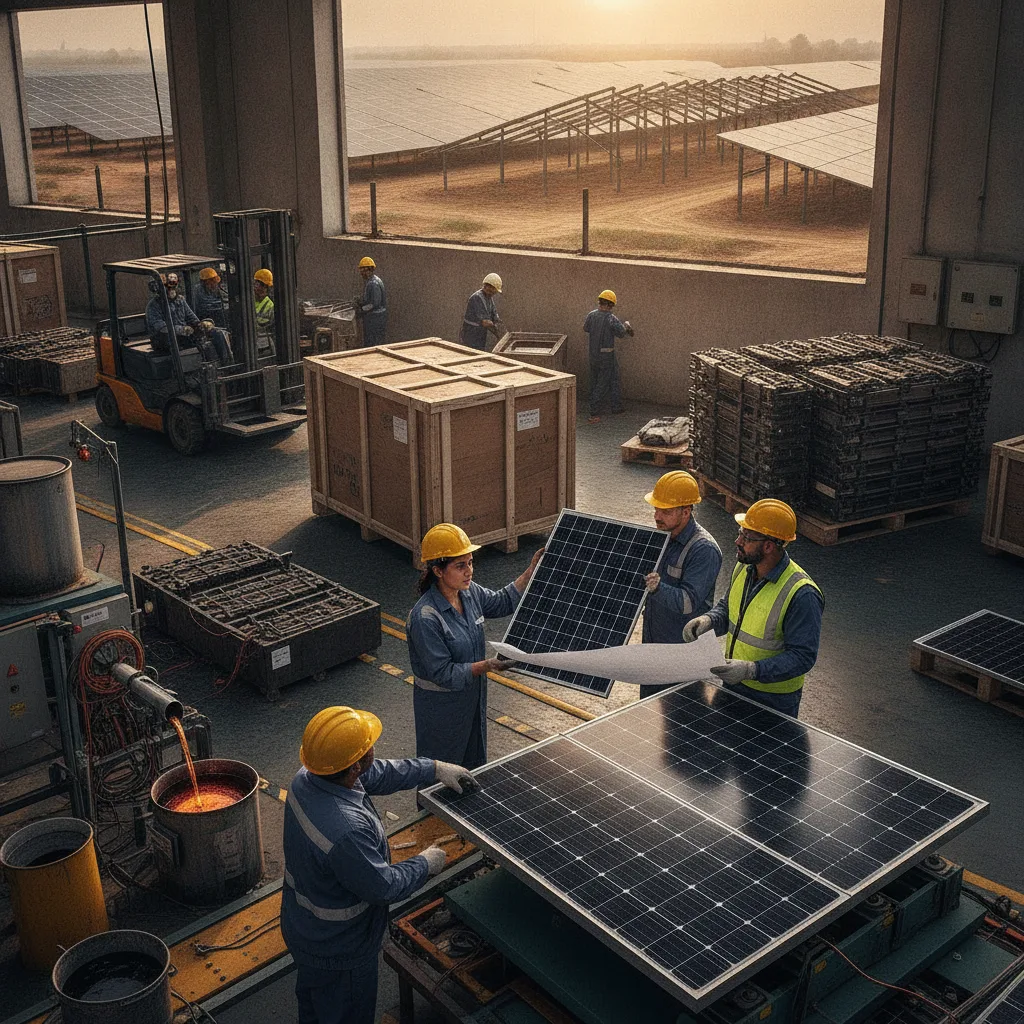
Companies like Waaree Energies, Tata Power Solar, and Vikram Solar have expanded factories. But India still imports most of its solar cells and almost all its polysilicon from China. Domestic cell output meets maybe 10% of demand. The rest comes from overseas.
"India's solar manufacturing is growing, but it's not yet ready to replace China," said a senior analyst quoted by DW. The country lacks a domestic polysilicon plant. Without that, any solar panel made in India still starts with Chinese material.
Europe's struggle to restart
Europe's solar story is different. It once made most of the world's panels. Then China undercut prices. By 2010, European production collapsed. Today, firms like Norway's REC Group and Germany's Solarwatt still make panels, but they are small players.
The European Union has tried to change that. In 2023, it set up the European Solar PV Industry Alliance. It aims to ramp up manufacturing to 30 GW per year by 2025. The EU also passed the Net-Zero Industry Act, which pushes for 40% of clean tech to be made inside the bloc by 2030.
But building factories takes time and money. European solar makers face high energy costs and stiff competition from cheaper Chinese imports. A 2023 report from the European Court of Auditors warned that EU solar manufacturing "faces serious challenges" and that current policies may not be enough.
Is it possible?
DW's analysis says yes, but not soon. Both India and Europe could build their own solar supply chains if they spend enough and accept higher prices. Chinese panels cost about 20% to 30% less than those made in India or Europe. That gap is hard to close.
India has a better shot at self-reliance than Europe, analysts say. It has cheap labor, growing energy demand, and a government willing to use tariffs. Europe, by contrast, has higher costs and less political will to block imports.
Neither region will cut China out completely anytime soon. But both are trying to build a backup, a way to make solar power without depending on Beijing if trade wars or crises hit.
For now, China remains the sun that lights the world's solar industry. India and Europe are still building their own mirrors.
Comments
Be the first to comment.
Leave a comment