Gujarat’s Khavda Solar Park hits 5 GW, aims for 30 GW by 2026
The sprawling solar park in the Rann of Kutch has crossed 5 gigawatts of operational capacity, with developers racing to hit 30 GW in just over two years.
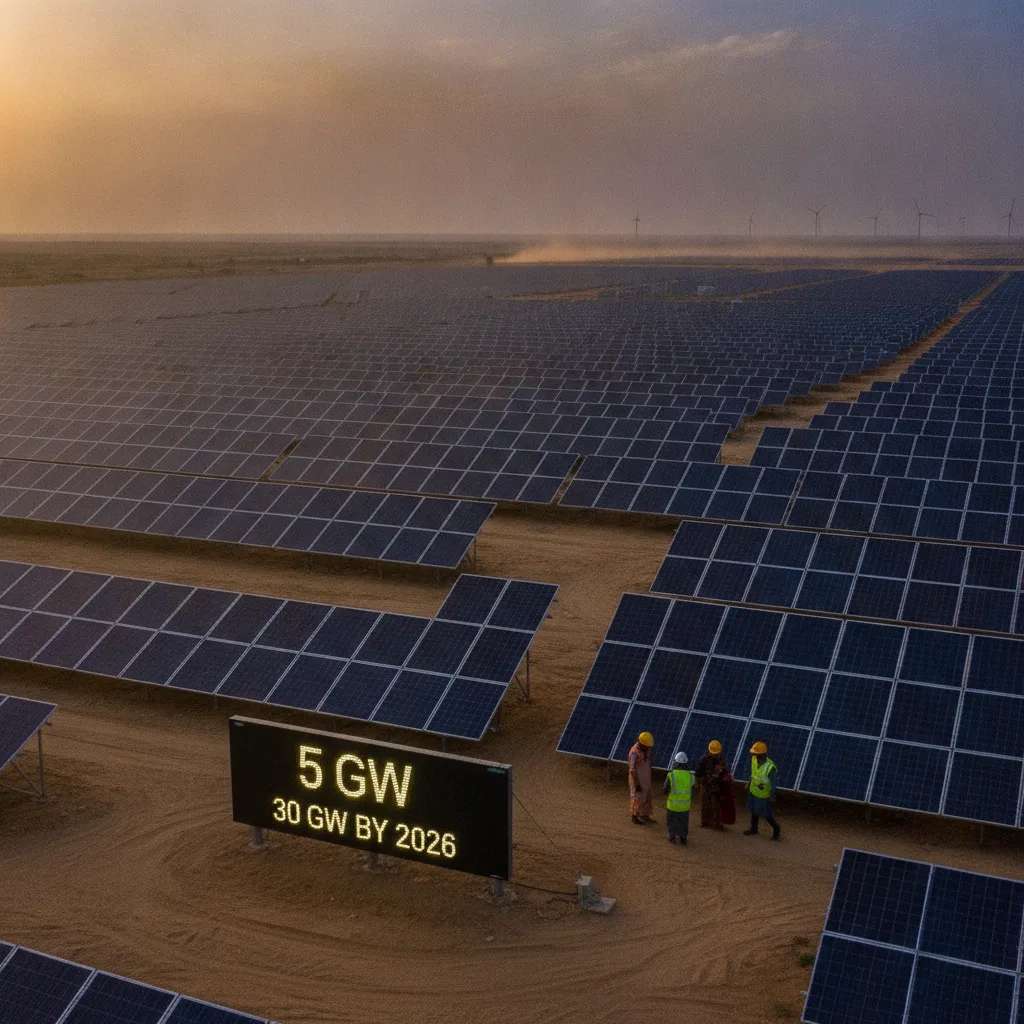
Khavda, Gujarat, The Khavda Solar Park, a massive renewable energy project spread across the salt flats of the Rann of Kutch, has crossed 5 gigawatts of installed capacity. That's enough to power roughly 4 million homes at peak output.
The park, being built by a mix of state-run and private developers, now covers over 200 square kilometers of what was once barren, flood-prone land. Adani Green Energy, the lead developer, says it has already commissioned 3.5 GW of that total. The rest comes from Gujarat State Electricity Corporation and other firms.
"We are adding about 1 GW every quarter," said a senior Adani Green official who spoke on condition of anonymity because he was not authorized to talk to the press. "The target is 30 GW by the end of 2026. That's a big ask, but the land is here, the grid is coming, and the sun is free."
Land and logistics
The Khavda site sits on government-owned wasteland near the Pakistan border. The terrain is flat but tricky, heavy monsoon rains turn the clay into mud, and dust storms are common in summer. Developers have built raised platforms for solar panels and laid hundreds of kilometers of new transmission lines.
Power Grid Corporation of India has set up a 765 kV substation at Bhuj, about 70 km south, to carry electricity from Khavda to the national grid. The company says the line can handle up to 8 GW now, with plans to double that by 2025.
Water is a bigger problem. The Rann gets less than 350 mm of rain a year. Solar panels need cleaning every two weeks to keep efficiency up. So developers truck in water from the Narmada canal, 150 km away. Some are testing dry-cleaning robots, but those are still expensive.
Jobs and local impact
The park has created about 12,000 construction jobs, mostly for workers from nearby villages like Khavda itself and Bhuj. Local contractors supply gravel, steel, and food. But the work is seasonal, monsoon rains halt construction from July to September.
"My son works as a welder here. He earns ₹25,000 a month, which is more than what we got from salt farming," said Jivabhai Thakor, a 60-year-old from a village 20 km away. "But when the rains come, he goes back to the farm. There's no work for three months."
The Gujarat government has promised a skill center in Bhuj to train locals for permanent operations and maintenance jobs. So far, that center has not opened.
Grid and storage
India's peak power demand hit 250 GW this summer, and solar parks like Khavda are key to meeting that without burning more coal. But solar only works when the sun shines. Without storage, Khavda's output drops to near zero after sunset.
Adani Green has announced plans for 5 GW of battery storage at the site, but that will cost about ₹12,000 crore ($1.4 billion) and is not yet financed. The company says it will start building the first 1 GW of storage next year.
"Solar without storage is just a daytime solution," said Dr. R. R. Nair, a professor of energy policy at IIT Gandhinagar who has visited the site. "If Khavda wants to be a round-the-clock power source, it needs batteries or pumped hydro. That's the next big hurdle."
What's next
By 2026, Khavda is expected to be the largest solar park on the planet, bigger than China's Tengger Desert park or the Bhadla park in Rajasthan. The state government has cleared land for another 100 square km. But land acquisition is still the bottleneck. Some farmers in nearby districts have filed court cases over compensation rates.
"We are not against solar," said Kanubhai Patel, a farmer from Rapar taluka whose land was taken for a transmission tower. "But the government paid us ₹2 lakh per acre. The market rate is ₹5 lakh. That's not fair."
For now, the park keeps growing. Workers are out before dawn, bolting panels onto rows of steel frames that stretch to the horizon. The next milestone, 10 GW, is expected by mid-2025.
Comments
Be the first to comment.
Leave a comment