
India's Rooftop Solar Surge: PM Surya Ghar Yojana Adds 1.2 GW in Q1 2025
The government scheme pushed India past 15 GW of cumulative rooftop solar capacity, with residential installations making up 70% of the new additions.
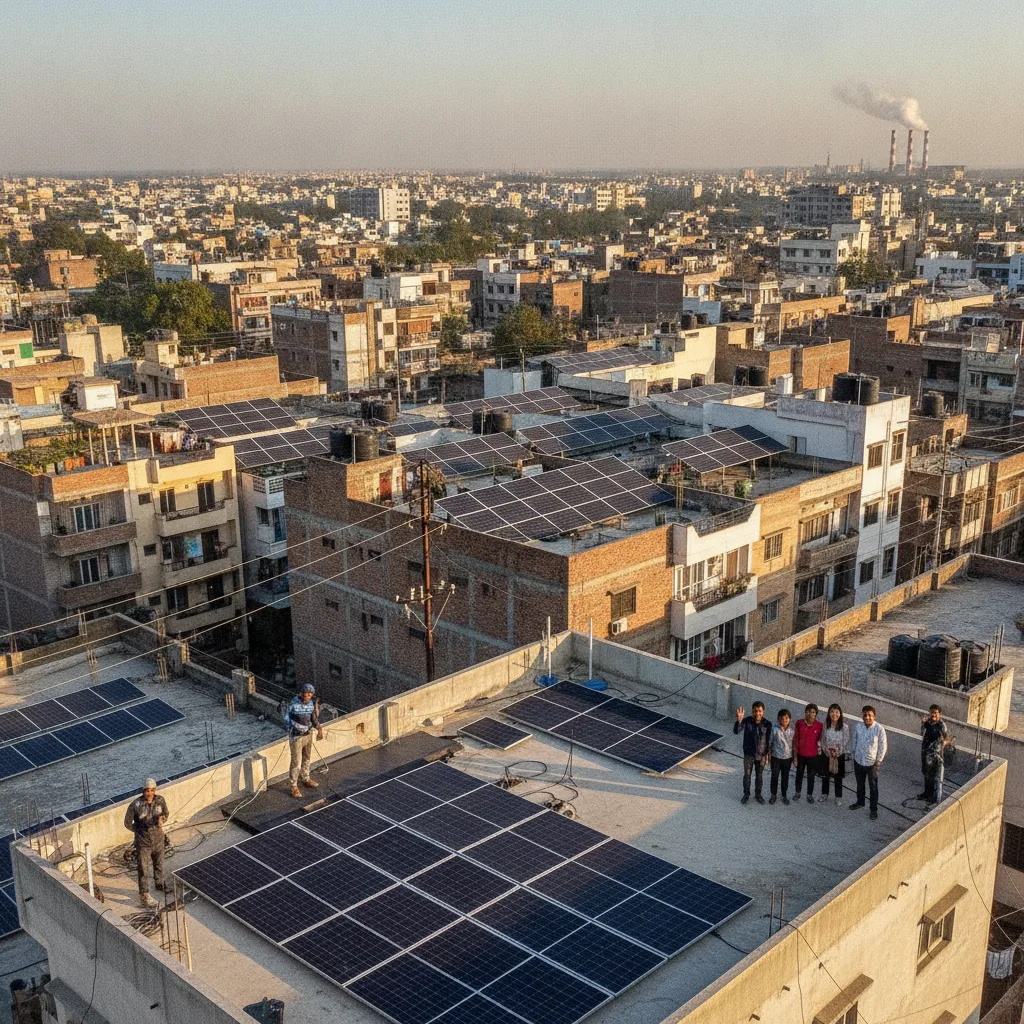
NEW DELHI, India added 1.2 gigawatts of rooftop solar capacity in the first three months of 2025, the highest quarterly jump ever. The PM Surya Ghar Yojana, launched just over a year ago, drove most of that growth.
New data from the Ministry of New and Renewable Energy shows the country's total rooftop solar capacity now stands at 15.4 GW. Residential rooftops accounted for 70% of the new installations. That is a sharp shift from earlier years, when industrial and commercial users dominated.
"We are seeing a real shift in who puts solar on their roof," said Rohan Singh, a senior analyst at the Council on Energy, Environment and Water in New Delhi. "Households are now the main drivers, not factories or offices."
The scheme gives households a subsidy of up to 78,000 rupees for a 3 kW system. It also offers low-interest loans through state banks. Over 2.5 million families have applied since the scheme began in February 2024. The government says it has approved 1.8 million of those applications.
Gujarat leads the pack with 320 MW added in Q1, followed by Maharashtra with 210 MW and Rajasthan with 145 MW. Tamil Nadu and Karnataka round out the top five.
But the boom is not spread evenly. Bihar and Uttar Pradesh, two states with high electricity demand and low solar uptake, added just 35 MW and 52 MW respectively. State officials blame slow approval processes and a shortage of trained installers.
"In Bihar, we have the demand but not the supply chain," said Meera Devi, a rooftop solar installer based in Patna. "Customers wait three months for panels and another month for the meter. That kills enthusiasm."
The government aims to reach 40 GW of rooftop solar by 2026. At the current pace, analysts say that target is within reach, but only if bottlenecks in distribution and grid connectivity get fixed.
Discoms, or power distribution companies, have been slow to approve net-metering connections. In some states, households wait six months or more to get the meter installed. The central government has asked state regulators to set a 30-day deadline for approvals. Only four states, Gujarat, Maharashtra, Rajasthan, and Karnataka, have complied so far.
Another hurdle: the quality of installations. A 2024 survey by the National Institute of Solar Energy found that 15% of rooftop systems had faulty wiring or poor panel alignment. The ministry has since launched a quality certification program for installers. Over 5,000 installers have signed up.
The price of rooftop solar has also dropped. A 3 kW system now costs around 1.4 lakh rupees, down from 1.8 lakh rupees in 2023. Cheaper Chinese panels and more efficient inverters have helped bring costs down.
"The economics work now," said Amit Kumar, a homeowner in Lucknow who installed a 3 kW system in January. "My electricity bill went from 2,500 rupees a month to 400 rupees. I will recover my investment in four years."
The Q1 surge also helped India's broader solar push. Total solar capacity, including utility-scale projects, reached 92 GW by end of March. The government has set a 2030 target of 280 GW.
But rooftop solar remains a small slice, about 17% of total solar capacity. The PM Surya Ghar Yojana aims to change that by targeting 10 million households by 2027.
"The first quarter shows what is possible when policy, price, and public demand align," said Singh. "The next challenge is to keep that momentum without leaving states like Bihar behind."
Comments
Be the first to comment.
Leave a comment