
India's solar pump push works but needs a second act
Millions of farmers have adopted solar irrigation pumps, but grid integration and fair pricing remain unfinished business.
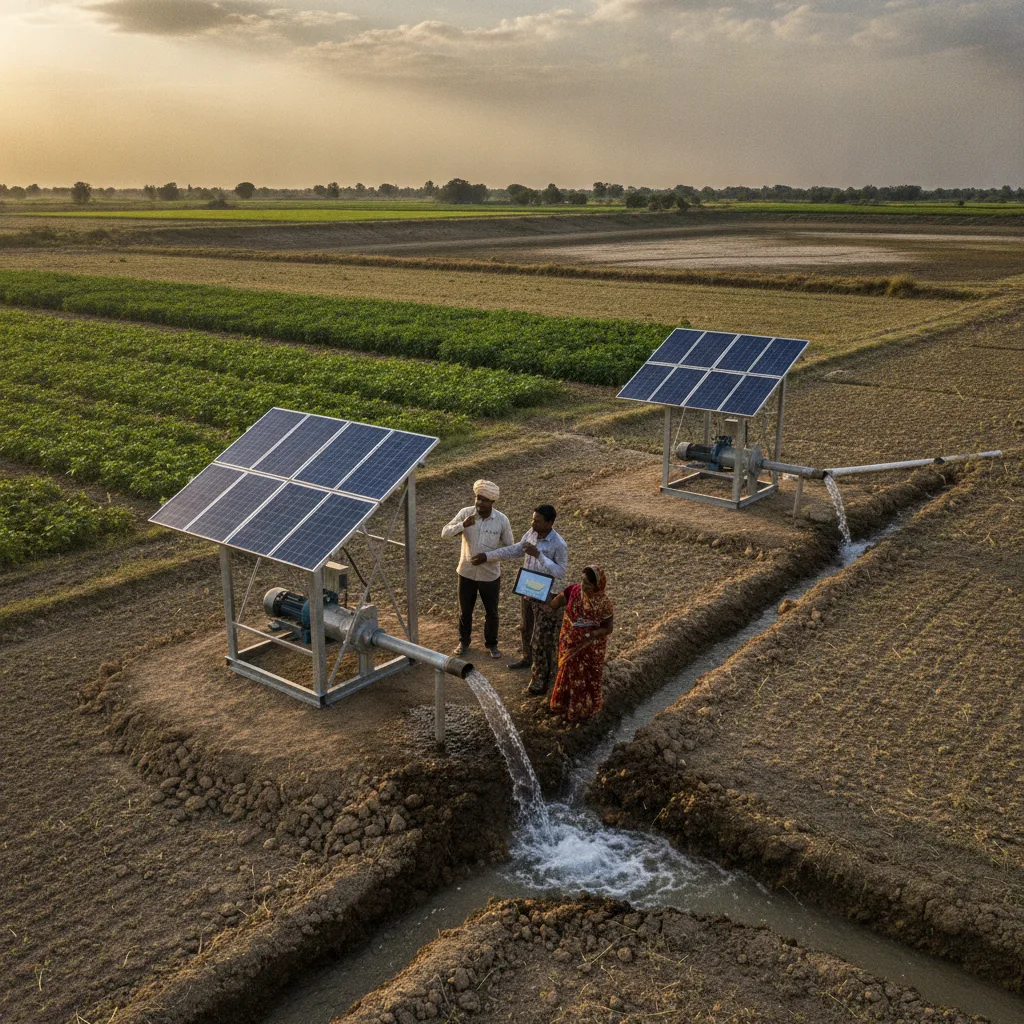
India has quietly built one of the world's largest solar irrigation programs. Over the past decade, the government has pushed farmers to swap diesel pumps for solar ones. The numbers are big, more than 3 million solar pumps are now in the field, according to government data cited in a recent ET EnergyWorld analysis.
But the job is only half done. The pumps work fine during the day, when the sun shines. But they sit idle at night. Farmers who irrigate after dark still fall back on diesel or grid power. That eats into the gains.
The problem is storage. Most solar pumps have no batteries. Without them, farmers cannot pump water when the sun is down. And many states have not set up systems to buy back extra solar power from farmers. So a farmer who generates more power than he needs during the day gets nothing for it.
What the first act achieved
The first phase of India's solar pump program focused on replacing diesel. It worked. The government's PM-KUSUM scheme, launched in 2019, aimed to put 2 million solar pumps in the field by 2022. That target has been scaled back, but states like Rajasthan, Maharashtra, and Gujarat have moved fast. Farmers in these states now irrigate without buying diesel, saving money and cutting emissions.
The scheme also helps the grid. Solar pumps feed power into the grid during peak sun hours, when demand from homes and factories is high. That reduces the need for coal-fired power plants to ramp up.
But the scheme has hit speed bumps. High upfront costs still scare off small farmers, even with government subsidies that cover up to 60 percent of the price. Banks are slow to lend. And in some states, distribution companies, the utilities that buy power from farmers, are reluctant to sign contracts. They worry about the cost of buying solar power at rates set by state regulators.
The second act: grid integration and fair pricing
The quiet revolution now needs a second act, say energy analysts cited in the ET EnergyWorld report. That means connecting solar pumps to the grid in a way that works for both farmers and utilities.
One model that works is the "feeder-level solarisation" approach tried in Gujarat. Instead of putting a solar panel on every farm, the state built larger solar plants that feed power directly to the agricultural feeders, the power lines that supply electricity to farms. Farmers get reliable daytime power without managing their own panels. The utility controls the plant and sells the extra power to the grid.
Another model is net metering for solar pumps. Under this system, a farmer's pump is connected to the grid. When the pump generates more power than the farm uses, the extra flows back to the grid and the farmer gets a credit on his bill. A few states, including Andhra Pradesh and Karnataka, have started pilot projects. But the rules vary wildly from state to state.
Water remains the tricky part. Solar pumps make it cheap to pump groundwater. That can lead to over-extraction, especially in water-stressed states like Punjab and Haryana. Some experts argue that any second act must tie solar subsidies to water-saving practices, like drip irrigation or crop diversification.
"The first act was about energy," the ET EnergyWorld article notes. "The second act has to be about energy plus water."
What comes next
The government is aware of the gaps. In late 2023, the Ministry of New and Renewable Energy revised the PM-KUSUM guidelines to allow more flexibility. Farmers can now install pumps smaller than the standard sizes, which lowers costs. The ministry also pushed states to set up single-window clearance for solar pump applications.
But the pace is still slow. As of mid-2024, only about 500,000 solar pumps had been installed under the PM-KUSUM scheme, far below the original target. The rest of the 3 million pumps in the field came from earlier state-level programs and private purchases.
For the second act to succeed, India needs to solve three things: cheaper financing for small farmers, uniform net metering rules across states, and a way to stop groundwater depletion. None of these is easy. But the first act showed that when the policy is right, farmers adopt fast.
Comments
Be the first to comment.
Leave a comment