
Punjab's Kisan Drone Yojana: Can Drones Cut Fertilizer Use and Water Waste?
The state government pushes agritech to fix a broken wheat belt, but farmers and experts question the costs and real-world gains.
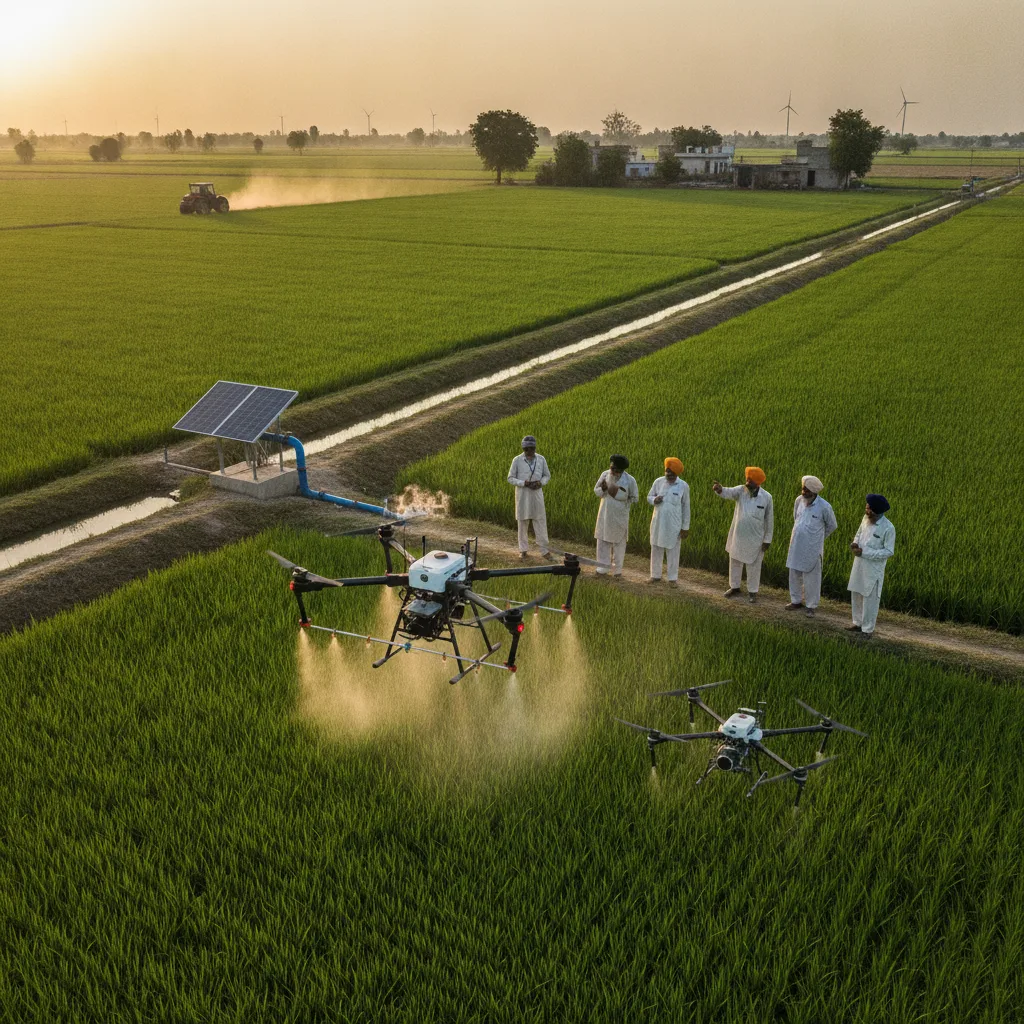
CHANDIGARH, In the flat, green fields of Punjab, a new sound is starting to cut through the morning air. It is not the rumble of a tractor or the clatter of a tube well. It is the high-pitched buzz of a drone.
Punjab launched the Kisan Drone Yojana in late 2023. The scheme offers farmers a 50% subsidy, up to ₹5 lakh, to buy drones for spraying fertilizers and pesticides. The goal is simple: use less water and fewer chemicals while raising yields in the state's overworked wheat and rice belt.
So far, the state has distributed over 200 drones. Officials say the number will hit 1,000 by the end of 2025.
"We are looking at a 20, 25% cut in fertilizer use and a 30% drop in water use," said Punjab Agriculture Director Jaswant Singh. "Drones spray with precision. They do not waste a drop."
But ask a farmer in Sangrur district, and you get a different story. "I bought a drone with the subsidy," said Balwinder Singh, who farms 25 acres of wheat. "But the battery lasts only 12 minutes. I need four batteries to cover my fields. Each one costs ₹1.5 lakh. The math does not add up."
The math is the sticking point. Punjab's average landholding is just 4 acres. A drone can cover that in under 10 minutes. But for larger farmers, the battery cost and downtime are real problems.
Still, supporters say the water savings alone could be huge. Punjab pumps more groundwater than any other Indian state. In some districts, the water table drops by a meter every year. Drones spray in narrow, targeted strips, unlike flood irrigation or broadcast spraying, which waste both water and chemicals.
"The real win is in the data," said Ritu Agarwal, a researcher at the Punjab Agricultural University in Ludhiana. "Drones can map fields and tell you exactly where to spray. You are not treating the whole field like a blanket. You treat only the sick spots."
That kind of precision farming is common in the U.S. and Europe. In India, it is still new. Punjab's scheme is one of the first large-scale state efforts to bring it to small farmers.
But critics point to a bigger problem. "Drones do not fix the root cause," said farmer leader Sukhdev Singh from Bathinda. "The government still pays us to grow wheat and rice with free power for tube wells. Why would anyone save water when electricity is free?"
The Punjab government spends ₹18,000 crore a year on free power for farmers. The drone scheme costs just ₹200 crore. Some say the drones are a distraction, a shiny tech fix for a broken policy system.
"We need to change what farmers grow and how they price water," said Dr. Amrit Kaur, an economist at Punjabi University in Patiala. "A drone is a tool. It is not a solution to over-extraction of groundwater or overuse of urea."
Punjab uses 1.5 million tonnes of urea every year, the highest per hectare in India. That has turned the soil acidic in many areas. Yields of wheat have plateaued at around 5 tonnes per hectare for the last decade.
Early results from drone spraying in the districts of Ludhiana and Moga show a 15% drop in urea use. But that is on fields run by the agriculture department, not by small farmers.
"The pilot projects look good," said Agarwal. "But scaling up is hard. A drone is not a phone. It needs training, maintenance, and trust."
For now, the buzz in Punjab is real. But whether it will change the way the state farms, or just add another machine to the shed, remains an open question.
"I will use the drone because I paid for it," said Balwinder Singh. "But I will still flood my fields. That is how I know the wheat will grow."
Comments
Be the first to comment.
Leave a comment