Karnataka's Free Solar Scheme Hits 40% Mark: 80,000 Low-Income Homes Get Rooftop Panels
The state's 'Gruha Jyothi' program, aiming to install free solar rooftops for 2 lakh low-income households, has reached 80,000 installations, but faces grid connectivity and awareness hurdles.
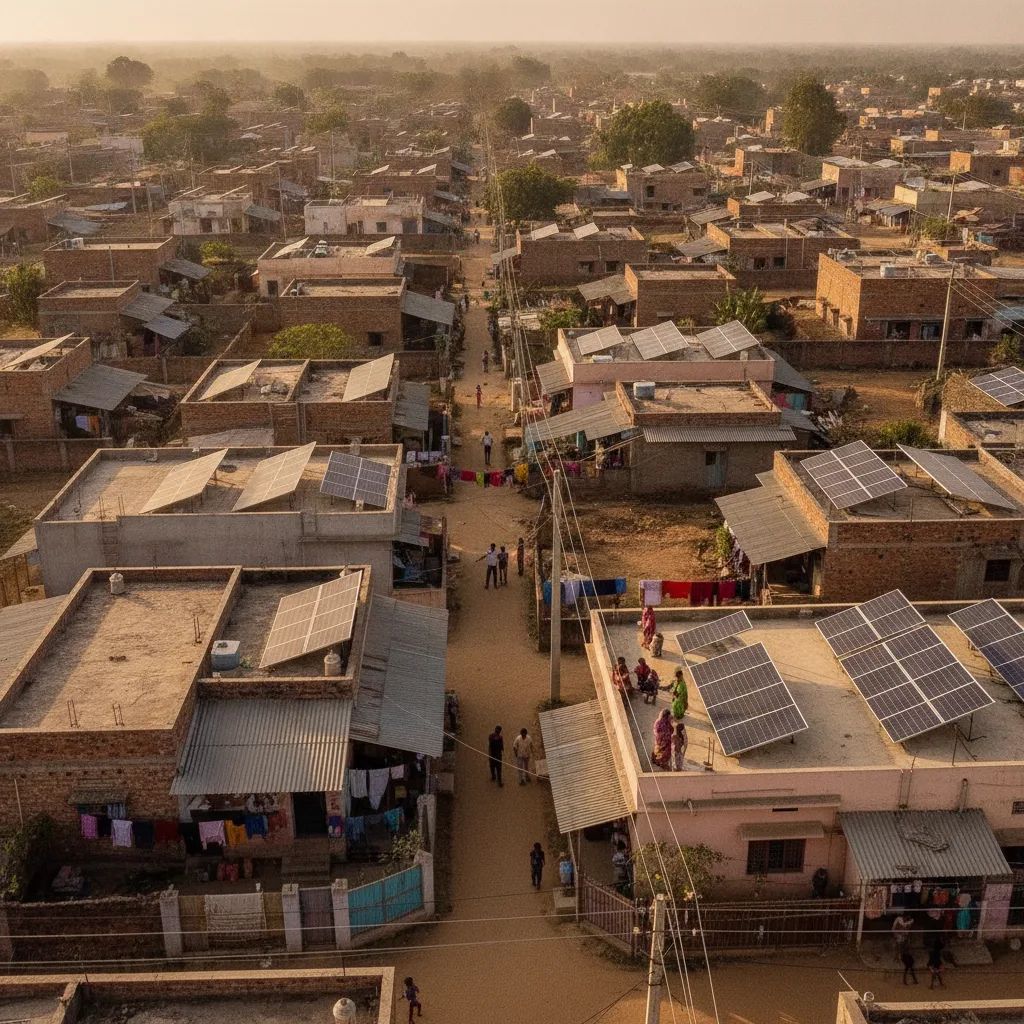
BENGALURU, Karnataka's ambitious 'Gruha Jyothi' scheme has crossed a key milestone. State officials say 80,000 low-income households now have free solar rooftop panels on their roofs. That is 40% of the target, 2 lakh homes.
The program, launched in July 2024, gives families with annual incomes below Rs 2.5 lakh a free 1-3 kW rooftop solar system. No upfront cost. The state picks up the full bill.
"We are moving faster than we expected," said N. Ravi Kumar, director of Karnataka Renewable Energy Development Ltd (KREDL), the agency running the scheme. "But the last mile is always the hardest."
How the scheme works
Households apply through the Seva Sindhu portal. A local empanelled installer checks the roof. If it passes, the system is installed within 30 days. The state pays the installer directly, Rs 30,000 for a 1 kW system, Rs 60,000 for 2 kW, and Rs 90,000 for 3 kW.
The power generated first goes to the home. Any extra flows to the grid. The household gets a bill credit for that surplus power at a feed-in tariff of Rs 3.50 per unit.
So far, the scheme has added 120 MW of rooftop solar capacity across the state. Most installations are in rural areas, Hassan, Mandya, and Tumakuru districts lead the pack.
Bottlenecks remain
Not everything is smooth. Grid connectivity is a big problem. Many homes in remote villages lack a stable grid connection. Without it, the solar system cannot feed surplus power back. Installers say they have to wait weeks for local electricity supply companies (ESCOMs) to clear the net metering applications.
"We have 1,200 completed installations just waiting for net meter approval," said Shankar Gowda, a project manager at SunRise Energy, one of the empanelled installers. "ESCOMs are short-staffed. They can't keep up."
Another hurdle: roof quality. Many low-income homes have thatched or tin roofs. They cannot hold the weight of solar panels. KREDL says it is testing lightweight mounting frames for such roofs, but those are not yet available at scale.
Awareness is also patchy. In some districts, families do not know they qualify. The government has run ads on local TV and radio, but word-of-mouth remains the main driver.
What households say
In Kolar district, 52-year-old Lakshmamma had solar panels installed on her two-room house in October. "My electricity bill used to be Rs 400-500 every month. Now it is zero," she said. "I can run my fan and TV without worrying."
But in Chitradurga, farmer Ramesh B. is still waiting. He applied in August. His roof was inspected in September. "They said my roof needs repair first. I don't have the money," he said.
KREDL says it is working with the state's rural development department to help patch up roofs for the poorest families. No timeline has been set.
Cost and funding
The scheme has a total budget of Rs 4,500 crore, spread over three years. The state government funds it entirely. No central subsidy is involved. So far, Rs 1,200 crore has been spent.
Karnataka is one of the few Indian states to offer fully free rooftop solar to low-income homes. Gujarat and Maharashtra have similar schemes, but they require households to pay a share, usually 10-20% of the cost.
Comments
Be the first to comment.
Leave a comment