
Maharashtra’s new agri-PV policy: ₹1.5/kWh tariff on 50,000 hectares of farmland
The state aims to put solar panels on 50,000 hectares of farmland, paying farmers ₹1.50 per kilowatt-hour for power fed into the grid.
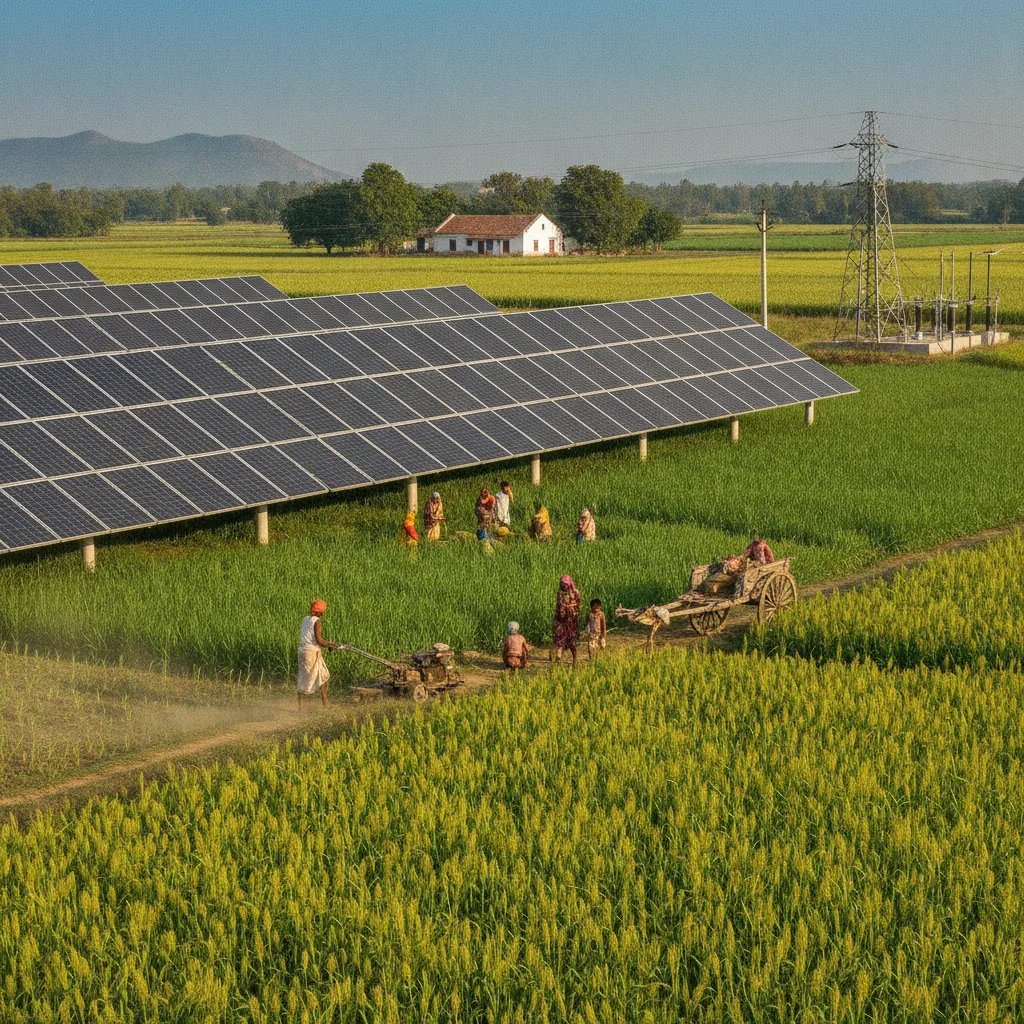
MUMBAI, The Maharashtra government has rolled out a policy to build solar plants on 50,000 hectares of farmland. Farmers who lease their land to developers will get ₹1.50 for every kilowatt-hour the panels send into the grid.
The scheme, called the Maharashtra Agrivoltaic Scheme 2024, was approved by the state cabinet on March 12. It runs for five years. The goal is to install 7,000 megawatts of solar capacity without pulling land out of food production.
"We are not taking farmland away from farming. We are putting solar above it," said a senior official in the state energy department, speaking on condition of anonymity because he was not authorized to talk to the press. "Crops grow underneath. The farmer gets a steady income from the panels."
Under the policy, a developer signs a 25-year lease with a farmer or a group of farmers. The developer pays the ₹1.50/kWh tariff for all electricity exported to the grid. The state electricity distribution company, Maharashtra State Electricity Distribution Company Limited (MSEDCL), buys that power under a long-term power purchase agreement.
The tariff is fixed for the first 15 years. After that, it drops to ₹1.00/kWh for the remaining 10 years.
Farmers keep ownership of the land. They can continue growing crops, vegetables, pulses, fodder, in the space between and under the panels. The policy mandates that at least 50% of the land area must remain available for farming. Developers must design the arrays so that tractors and laborers can move through them.
Maharashtra has roughly 22 million hectares of farmland. The 50,000 hectares set aside for agri-PV is about 0.23% of that. But the state hopes this small slice can start a shift.
"This is a test bed," said Rohan Kulkarni, an energy analyst at the Pune-based Centre for Energy Studies. "If it works, you could see farmers in Vidarbha and Marathwada, places with poor rainfall and high debt, turn their thin soil into a power plant."
The policy also offers a capital subsidy of ₹1 crore per megawatt for the first 500 MW of projects. That money comes from the state budget and from central government schemes like the PM-KUSUM program.
Developers must pick districts where the local grid can handle the extra power. A list of eligible districts will be published by the Maharashtra Energy Development Agency (MEDA) within 60 days. MEDA will also run the bidding process, which starts in June 2024.
Not everyone is sold on the idea. Environmental groups worry about the water needed to wash the panels. A solar array on a hectare of land can need 10,000 to 15,000 liters of water per cleaning cycle in dry months. In drought-prone regions, that water might come from borewells that already run low.
"Cleaning panels with groundwater in a water-scarce district is a bad trade," said Sunita Narain, director of the Delhi-based Centre for Science and Environment. "The policy should tie water use to rainwater harvesting. Without that, you risk swapping one crisis for another."
The state says it will push developers to use dry-cleaning robots or treated wastewater. But the policy document does not make either method mandatory.
Another issue is the size of the lease payment. The ₹1.50/kWh tariff is about 30% lower than what a utility-scale solar farm gets in Maharashtra. Developers say that's because agri-PV costs less, no need to buy land, just lease it.
Farmers, however, may not see big money. On a typical one-hectare plot with 200 kW of panels, a farmer might earn ₹2.25 lakh per year from the lease. That is roughly ₹18,750 a month. For a smallholder with two hectares, it could double their household income.
"It's not a fortune, but it's steady," said Prakash Jadhav, a sugarcane farmer from Satara who attended a consultation meeting on the policy. "My crop income swings with the rain. The solar check comes every month, rain or shine."
The policy sets no upper limit on the number of projects. Developers can bid for any size, from a single farmer's plot to a cluster of 100 hectares. MEDA will approve projects within 90 days of application.
Comments
Be the first to comment.
Leave a comment