
PM-KUSUM Scheme Hits 5 GW Solar Pump Installations: Ground Report from Rajasthan's Dark Zones
India's flagship solar pump scheme reaches 5 gigawatts, but farmers in Rajasthan's power-starved 'dark zones' say the real test is still ahead.
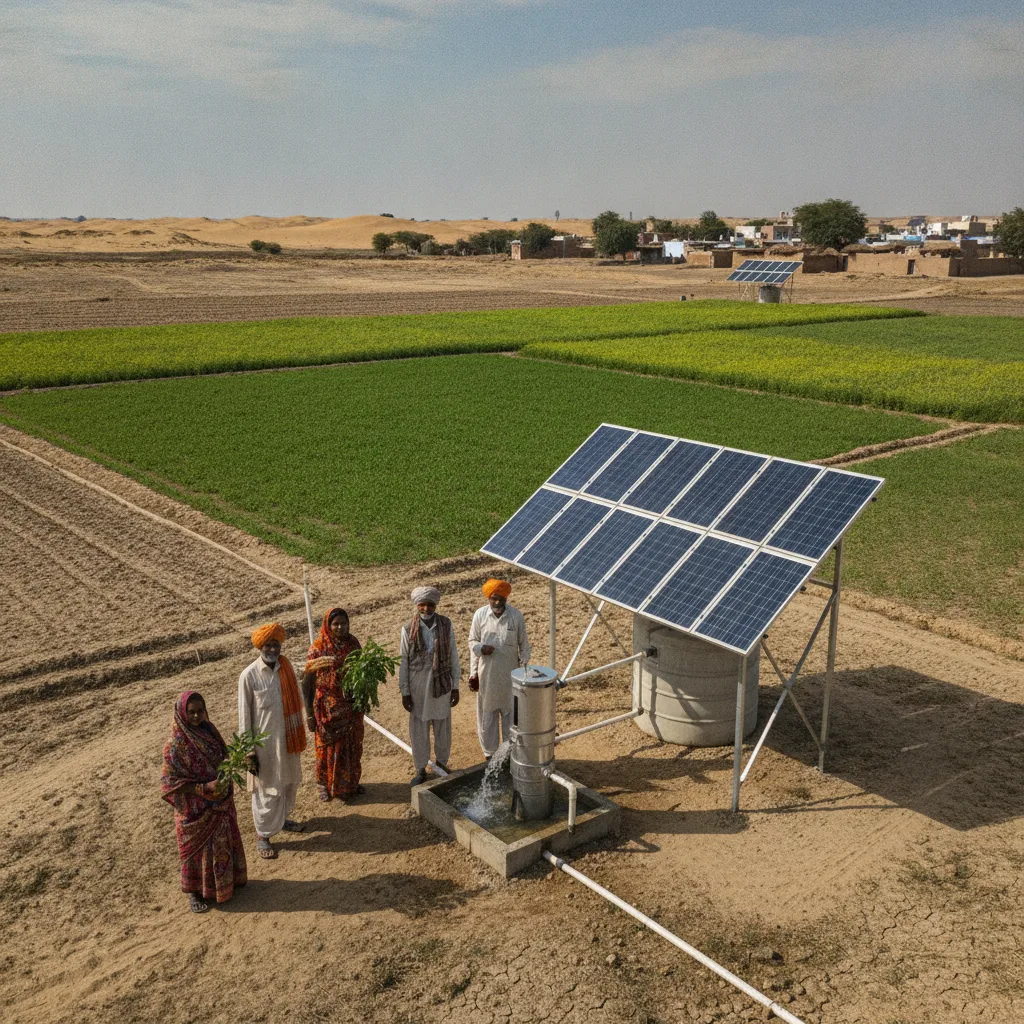
JAIPUR, The Indian government says it has installed 5 gigawatts of solar pumps under the PM-KUSUM scheme. That's enough to power 1.5 million farms. But out in Rajasthan's kala kshetra, the dark zones where power cuts run 12 hours a day, the story is more complicated.
On a dusty afternoon in Barmer district, farmer Gopal Ram Chaudhary stood next to his new solar pump. It hummed quietly, drawing water from 200 feet below. "This is the first time I have seen water without diesel smoke," he said. "But the pump only works when the sun is high. I need water at dawn too."
Chaudhary is one of 15,000 farmers in Barmer who got a solar pump under the scheme. The state government says it has installed 1.2 lakh pumps across Rajasthan. Nationally, the Ministry of New and Renewable Energy claims 5 GW of solar capacity from pumps as of March 2025. That's up from 1.2 GW in 2022.
But there's a catch. The scheme's third component, Component C, which lets farmers sell surplus power back to the grid, is barely moving. Only 20,000 farmers have signed up in Rajasthan. The state's power distribution company, Jaipur Vidyut Vitran Nigam, blames low tariffs. "We pay ₹3.15 per unit. Farmers want ₹5," said an official who asked not to be named.
Dark zones and bright spots
Rajasthan has 42 dark zones, areas where groundwater is so low that the state bans new electric connections. Solar pumps are the only option. In these zones, the scheme is a lifeline. But it's a fragile one.
Take the village of Bhadrajun. Last summer, the solar pump ran dry for three weeks because the water table dropped. "The sun was strong. The pump was strong. But the well was empty," said village head Manohar Singh. The scheme does not pay for deepening wells or storing water. Farmers are on their own.
Still, the numbers show real growth. The scheme has cut diesel use by an estimated 1.5 billion litres a year. That's ₹8,000 crore saved in fuel costs. Carbon emissions are down by 3 million tonnes. "It's a start," said Dr. Priya Sharma, an energy analyst at the Centre for Science and Environment. "But 5 GW is just 10% of the target. The scheme aimed for 30 GW by 2026. We are way behind."
Money and maintenance
The biggest hurdle is money. A 5-horsepower solar pump costs about ₹1.5 lakh. The central government pays 60%. The state pays 30%. The farmer pays the rest. For small farmers, even ₹15,000 is a lot. Many take loans. Some skip maintenance.
In Jodhpur district, technician Rakesh Kumar repairs solar pumps for a living. He sees the same problems again and again. "Dust clogs the panels. Rats chew the wires. Farmers don't clean them. They think the sun will fix everything," he said. "It doesn't."
The government has set up 1,200 repair centers across Rajasthan. But farmers in remote areas say they wait weeks for a technician. "I called three times. No one came," said Chaudhary. "I fixed it myself with tape and wire."
What works
In some places, the scheme works well. In Jalore district, farmer groups pool their pumps and share the water. They also sell surplus power to the grid. "We made ₹50,000 last year from selling power," said group leader Ramesh Kumar. "That paid for the pump and the repairs."
The Rajasthan government is now pushing for a higher tariff. It has asked the central government to raise the rate to ₹4.50 per unit. A decision is pending. Meanwhile, the state is testing battery-backed solar pumps. These store power and work after sunset. Twenty-five pilot units are running in Barmer.
"We need to move from just installing pumps to making them useful all day," said Sharma. "Otherwise, the dark zones will stay dark."
Comments
Be the first to comment.
Leave a comment