
PM-KUSYAL Scheme Crosses 4 Million Solar Pumps: Can It Meet the 2030 Target of 17.5 Million?
India's flagship solar pump program hits a new milestone, but the gap to the 2030 goal remains vast.
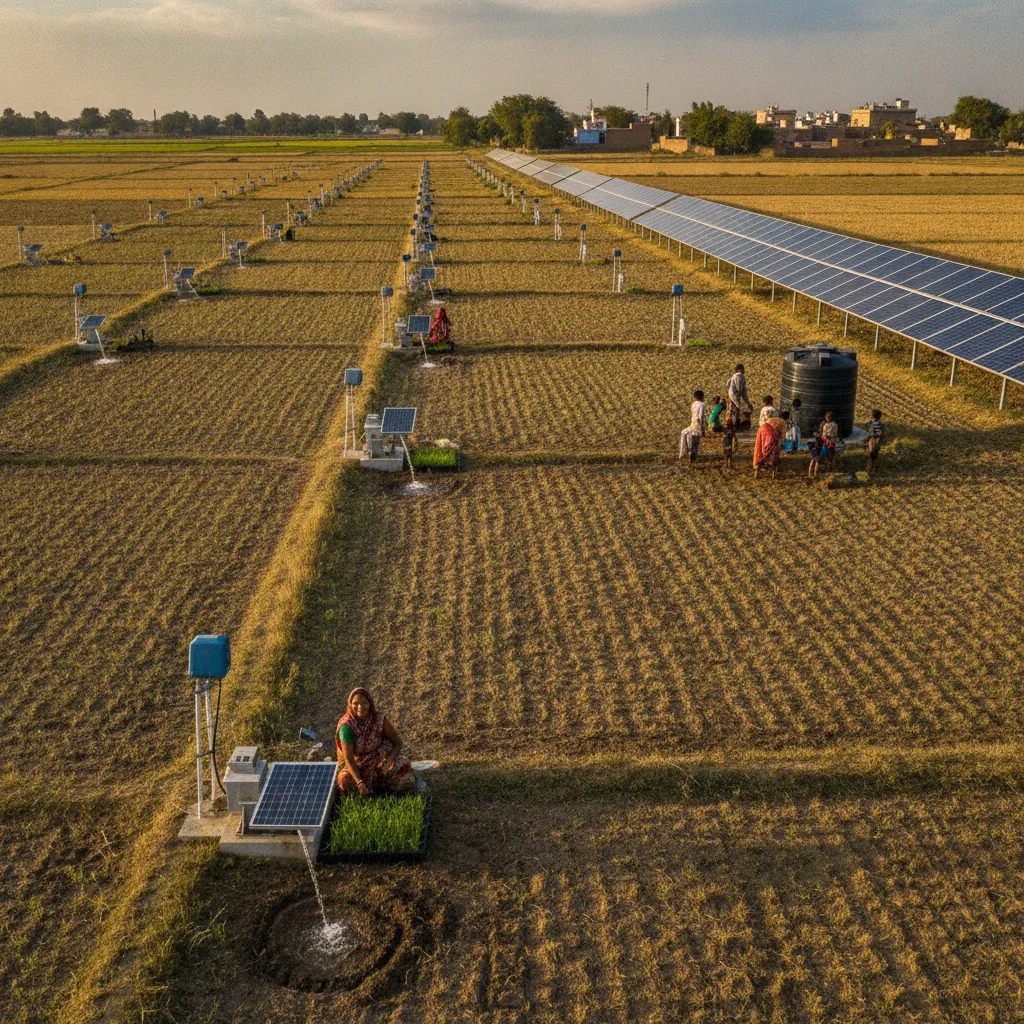
NEW DELHI, India's PM-KUSYAL scheme has now put 4.2 million solar water pumps in farmers' fields. The Ministry of New and Renewable Energy (MNRE) announced the number on March 12, 2025. It's a big jump from 2.8 million in January 2024. But the target is 17.5 million by 2030. That leaves 13.3 million pumps to install in less than five years.
The scheme started in 2019. It gives farmers a big subsidy to swap diesel or grid-powered pumps for solar ones. The goal is to cut diesel use, save money for farmers, and reduce emissions. So far the program has saved an estimated 6.2 billion liters of diesel a year, according to MNRE data. That's worth about ₹38,000 crore in avoided fuel costs.
The numbers game
To hit 17.5 million by 2030, India needs to install roughly 2.7 million pumps a year. Last year the count was about 1.4 million. That's half the needed rate. "We are pushing hard," said a senior MNRE official who spoke on condition of anonymity. "But supply chains and farmer awareness take time."
Rajasthan leads with 1.1 million pumps. Maharashtra follows with 890,000. Uttar Pradesh has 760,000. These three states account for nearly two-thirds of all installations. But many other states lag far behind. Bihar has only 140,000 pumps. West Bengal has 95,000. The gap is wide.
Cost is another hurdle. A 3-horsepower solar pump system costs about ₹1.5 lakh. The central subsidy covers 30% to 50%, depending on the state. Farmers still pay ₹75,000 to ₹1 lakh upfront. For small landholders, that's a lot of money. Many take loans. Some don't bother.
Ground realities
I visited a village in Jodhpur district last month. Farmer Ramesh Chaudhary got a solar pump in 2022. "My diesel bill was ₹8,000 a month. Now it's zero," he told me. But his neighbor, Prakash Meena, hasn't applied. "The paperwork is too much," Meena said. "And I heard the pumps break often."
Maintenance is a real problem. A 2024 study by the Council on Energy, Environment and Water (CEEW) found that 22% of solar pumps in five states had broken down within two years. Farmers waited weeks for repairs. The scheme does not include a service contract. The manufacturer is supposed to fix it, but many companies have no local service centers.
Water use is another worry. Solar pumps let farmers pump more water for free. That can drain aquifers faster. A 2023 paper in Environmental Research Letters showed that in water-scarce districts of Gujarat, solar pumps increased groundwater extraction by 15% to 25%. The government is testing "solar irrigation cooperatives" that cap pumping. But only 200 such pilots exist.
Policy fixes in the works
MNRE says it is updating the scheme. New rules may require manufacturers to set up service centers in every district. The subsidy may go up to 60% for small farmers. Digital applications are being simplified. A single-window portal will launch in April 2025, officials say.
"We need to double the installation rate," said Dr. Sunita Narain, director of the Centre for Science and Environment. "But we also need to manage water demand. Otherwise the pumps will solve one problem and create another."
The 2030 target is ambitious. At the current pace, India will hit about 10 million pumps by then. That's still a big number, more than any other country has installed. But 17.5 million? It will take faster approvals, better maintenance, and smarter water rules. For now, Chaudhary is happy. "My pump works. I save money. That's enough for me," he said.
Comments
Be the first to comment.
Leave a comment