
Rajasthan's Bhadla Solar Park Turns to Dry-Cleaning Robots as Water Runs Short
A new agritech start-up is testing robotic dusters that cut water use by 90% at the 2.5 GW Bhadla Solar Park, where a severe water shortage threatens panel efficiency.
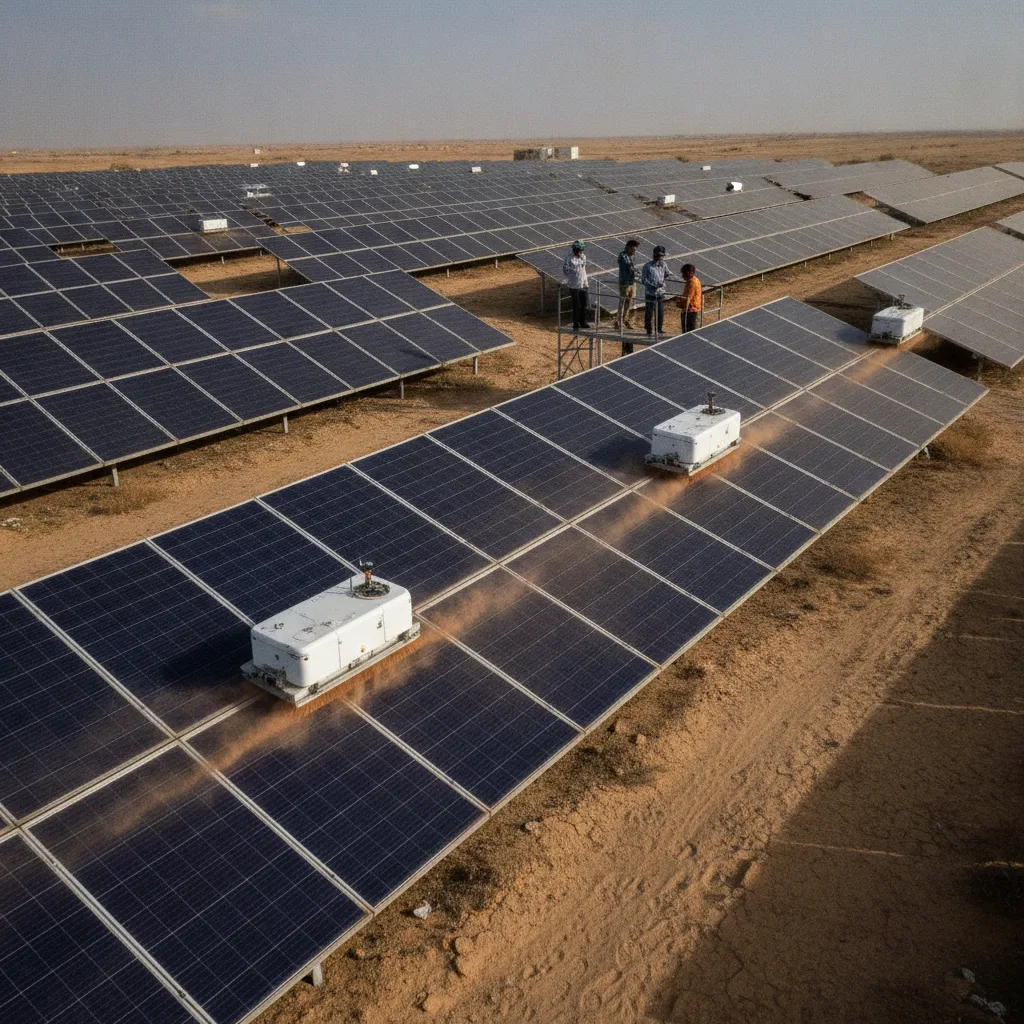
BHADLA, Rajasthan, The world's largest solar park is running out of water. Not for cooling, but for cleaning.
Bhadla Solar Park, a 2.5 GW sprawl of panels across 14,000 acres of Thar Desert sand, needs millions of litres of water every month to wash off dust. Without cleaning, efficiency drops by 40% in two weeks. But Rajasthan's drought-hit districts can't spare the water.
Now a small Jaipur-based start-up, DustAway Robotics, thinks it has a fix: robotic dry-scrubbers that use 90% less water.
"We started with a simple question, why are we pouring drinking-grade water on solar panels in a desert?" said Rohan Deshmukh, DustAway's co-founder. "The answer was 'because that's how it's always been done.' We wanted to change that."
Their machine, called the DusterBot 2000, runs on a lithium battery and uses spinning microfiber rollers to lift dust. A fine mist of recycled water, just 200 millilitres per panel, knocks off the last grit. The whole thing moves on rubber tracks between the rows.
NTPC, which operates a 1 GW block of the park, started a three-month trial on 50 megawatts of panels in February. Early results show the bots keep panels at 98% of clean efficiency while using a tenth of the water.
How bad is the water problem?
Bhadla gets less than 200 mm of rain a year. The nearest reliable water source is the Indira Gandhi Canal, 60 km away. Tanker trucks bring 40,000 litres per trip. Each trip costs ₹4,500.
"We spend about ₹2.5 crore a month on water alone for cleaning," said Sunita Meena, a site manager at Bhadla who oversaw the trial. "That's not counting the diesel for the trucks. The robots could cut that bill in half."
The park employs 1,200 people, many of them women from nearby villages, who manually wipe panels with long-handled squeegees. They work in 45°C heat. DustAway says the robots don't replace jobs, they redeploy workers to monitor the bots and fix broken panels.
"I used to scrub 300 panels a day," said Kamla Devi, a worker from Bhadla village. "Now I drive the robot with a tablet. My back doesn't hurt anymore."
A wider crisis for Indian solar
India has 65 GW of installed solar capacity, most of it in arid states. The Ministry of New and Renewable Energy estimates that dust cuts national solar output by 12% on average, enough to power 10 million homes.
Traditional wet-cleaning uses 1.5 to 2 litres of water per panel. At Bhadla, that means 6 million litres a month for the whole park. With the DusterBot, that drops to 600,000 litres.
But water isn't the only issue. The robots cost ₹8 lakh each. DustAway leases them for ₹15,000 a month, including maintenance. NTPC is now talking to the company about a full roll-out across its 1 GW block by October.
Other parks are watching. The 2.2 GW Pavagada Solar Park in Karnataka, which faces its own water shortages, has asked for a demo. So has the 600 MW Rewa Ultra Mega Solar plant in Madhya Pradesh.
"This is not a silver bullet," Deshmukh said. "But if we can save 5 million litres of water a month at one park, and that tech spreads to ten parks, we're talking real numbers."
The DusterBot 2000 went into full production last week at a factory in Bhiwadi. DustAway says it has orders for 120 units so far.
Comments
Be the first to comment.
Leave a comment