India's EV penetration hits 12% for first time in June, e2Ws lead the way
Electric vehicle sales crossed the 12% mark for the first time in June, driven by two-wheelers, with total EV registrations rising over 20% from a year ago.
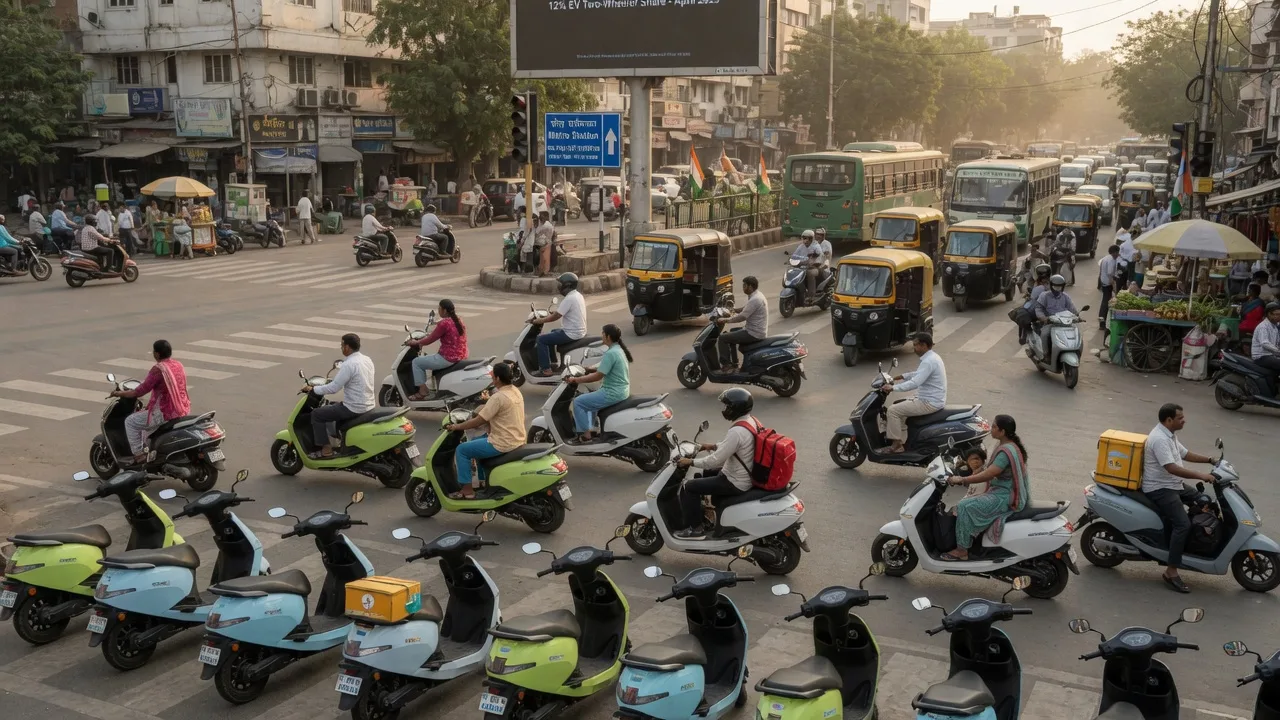
India's electric vehicle market hit a new milestone in June. EV penetration, the share of electric vehicles in total auto sales, crossed 12% for the first time, according to data from the government's Vahan portal. The jump was led by electric two-wheelers (e2Ws), which accounted for the bulk of registrations.
Total EV registrations in June stood at roughly 1.3 lakh units, a rise of more than 20% compared to the same month last year. E2Ws made up around 70% of those numbers. Three-wheelers and passenger cars also grew, but at a slower pace.
E2Ws drive the charge
Electric two-wheelers have become the backbone of India's EV story. In June, e2W registrations crossed 90,000 units, a record monthly figure. Industry sources point to new model launches, state subsidies under the FAME II scheme, and a growing network of charging points as key drivers.
Ola Electric led the pack with over 35,000 units sold, followed by TVS Motor and Bajaj Auto. Smaller players like Ather Energy and Hero Electric also posted strong numbers. The top five companies together controlled nearly 80% of the e2W market.
Three-wheelers and cars lag
Electric three-wheelers, mostly used for last-mile freight and passenger transport, registered about 30,000 units in June. That's a 15% jump from a year ago, but penetration remains low compared to two-wheelers.
EV passenger cars, meanwhile, remain a niche. Tata Motors and MG Motor together sold around 5,000 units in June. That's less than 2% of total car sales in the country. High upfront costs and limited model choices continue to hold back buyers.
"The two-wheeler segment is where the action is," said an analyst at a New Delhi-based clean energy think tank, speaking on condition of anonymity. "For cars, we need better battery technology and more affordable models before we see a real shift."
Policy push and challenges ahead
The government's FAME II scheme, which provides subsidies for electric two- and three-wheelers, is set to expire in March 2024. Industry bodies have asked for an extension. The scheme has been a mixed bag, it helped push sales, but also led to allegations of subsidy misuse by some companies.
Charging infrastructure remains a bottleneck. As of June, India had roughly 5,000 public charging stations, mostly in big cities. Rural and highway coverage is thin. Battery swapping, especially for two-wheelers, is seen as a stopgap solution.
State-level policies have also played a role. Gujarat, Maharashtra, and Karnataka offer extra subsidies on top of the central scheme. Those three states alone accounted for nearly 40% of all EV registrations in June.
"The 12% mark is a good sign, but it's not a breakthrough," said the analyst. "We need sustained growth for three to four years to build real momentum."
India's overall auto market remains dominated by petrol and diesel vehicles. Two-wheelers, which make up more than 70% of all vehicles sold in the country, are the key battleground. If that segment keeps climbing, the 12% figure could become a floor, not a ceiling.
Comments
Be the first to comment.
Leave a comment