
Tamil Nadu Wind Output Falls 22% in Q1 2025; Grid Seeks Storage Fix
A sharp drop in wind power generation during the first quarter of 2025 has pushed Tamil Nadu's grid operators to call for large-scale battery storage to manage seasonal swings.
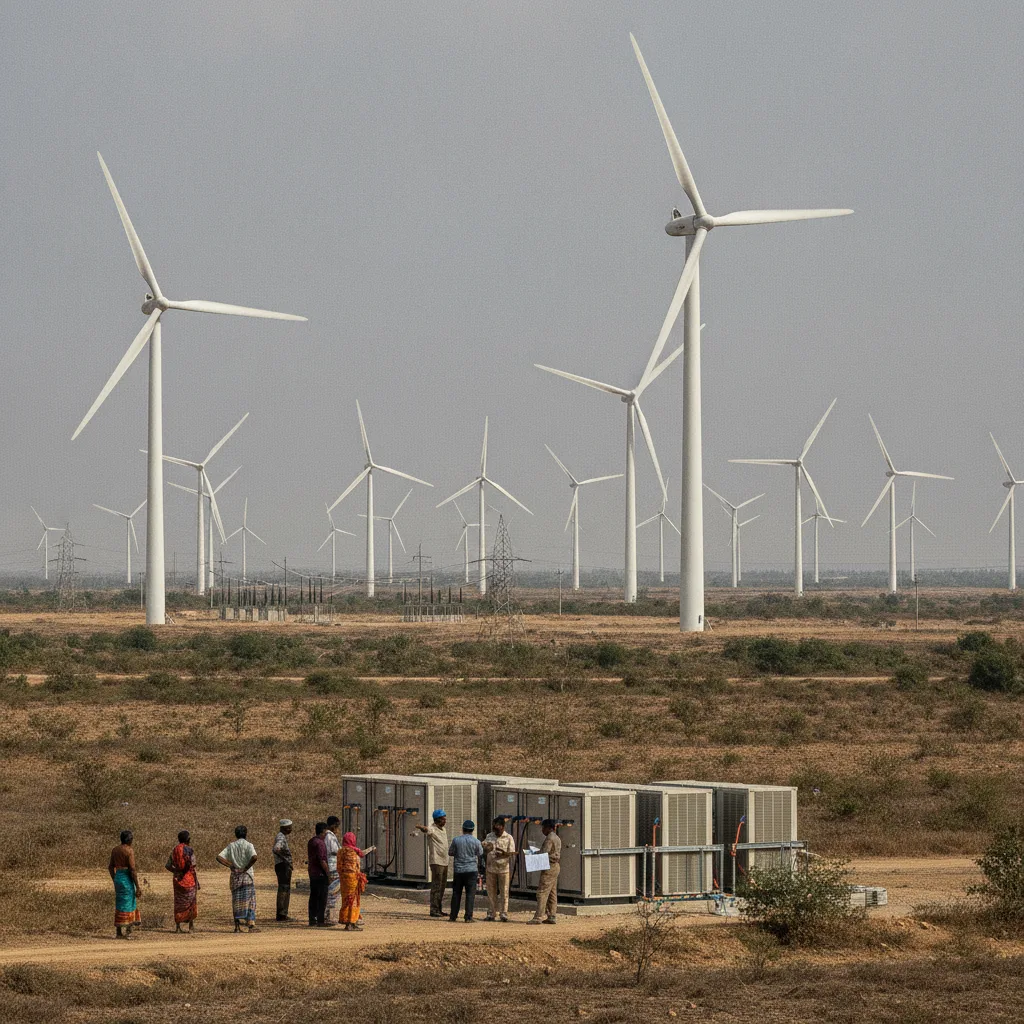
CHENNAI, Tamil Nadu's wind farms produced 22% less electricity in the first three months of 2025 compared to the same period last year. Grid operators say the slump shows why the state needs to build storage capacity fast.
Data from the Tamil Nadu Generation and Distribution Corporation (Tangedco) shows wind output fell to 4,210 million units in Q1 2025, down from 5,398 million units in Q1 2024. The drop comes despite a 5% increase in installed wind capacity, now at 10,500 MW.
Why the drop?
Low wind speeds are the main reason. The Indian Meteorological Department recorded average wind speeds of 4.2 meters per second in Tamil Nadu's key wind belts, Muppandal, Kayathar, and Tirunelveli, during January to March. That's 18% below the five-year average for the quarter.
"This is not a one-off," said K. R. Sivaram, a grid management officer at Tangedco who asked to remain unnamed as he is not authorized to speak to the press. "We see these dips more often now. The wind pattern is shifting. We need storage to keep the grid stable."
Tamil Nadu depends heavily on wind. It accounts for nearly 30% of the state's total installed renewable capacity. But wind is fickle. On good days, turbines run at 35-40% capacity. On bad days, that number drops to 10% or less.
The drop in Q1 2025 forced Tangedco to buy more power from coal plants and from the national grid. That pushed up the state's average power purchase cost by 12% compared to Q1 2024, according to a state power department report reviewed by GreenEarth News.
Storage: the missing piece
Grid operators have been asking for battery storage for years. Tamil Nadu's current storage capacity is near zero. The state has no utility-scale battery plant in operation. A 50 MW / 200 MWh project proposed in 2023 near Tirunelveli is still stuck in land acquisition talks.
"Storage is not a luxury. It is a necessity," said M. P. Ramalingam, a renewable energy consultant who worked with the state's energy department until 2024. "Without it, we waste wind power when the wind blows at night and scramble for coal when it stops."
India's central government has set a target of 500 GW of non-fossil fuel capacity by 2030. But storage deployment has lagged. As of March 2025, India had only 2.2 GWh of grid-scale battery storage, according to the Central Electricity Authority. Tamil Nadu's share is 0.
The state government has announced plans to add 2 GW of pumped hydro storage by 2028. Two sites, one in Nilgiris and one near Sathyamangalam, are under survey. But pumped hydro projects take 6 to 8 years to build. Battery storage can be installed in 12 to 18 months.
"We need both," said Sivaram. "But we need batteries now. The wind won't wait."
Wind developers are also feeling the pinch. The drop in generation means lower revenue for project owners. Many smaller operators in Muppandal, a cluster of 1,500 MW of old wind turbines, have seen their cash flow shrink by 20-25% in Q1 2025, according to the Indian Wind Power Association.
The association's secretary, S. R. Rajan, said the state should offer incentives for repowering older turbines with taller towers and bigger blades. "Newer turbines can generate 30-40% more energy even at lower wind speeds. But that needs capital. The state must step in."
For now, Tangedco is banking on a 500 MW solar-wind hybrid tender it floated in February 2025. The tender requires bidders to include at least 4 hours of battery storage. Results are expected in June.
"That's a start," said Ramalingam. "But 500 MW is a drop. We need 5,000 MW of storage by 2030. The clock is ticking."
Comments
Be the first to comment.
Leave a comment