
How battery demand for grid storage could raise India's EV prices
India's push for battery energy storage systems (BESS) to back up solar and wind power may tighten lithium-ion supply and slow the cost drop for electric vehicle batteries.
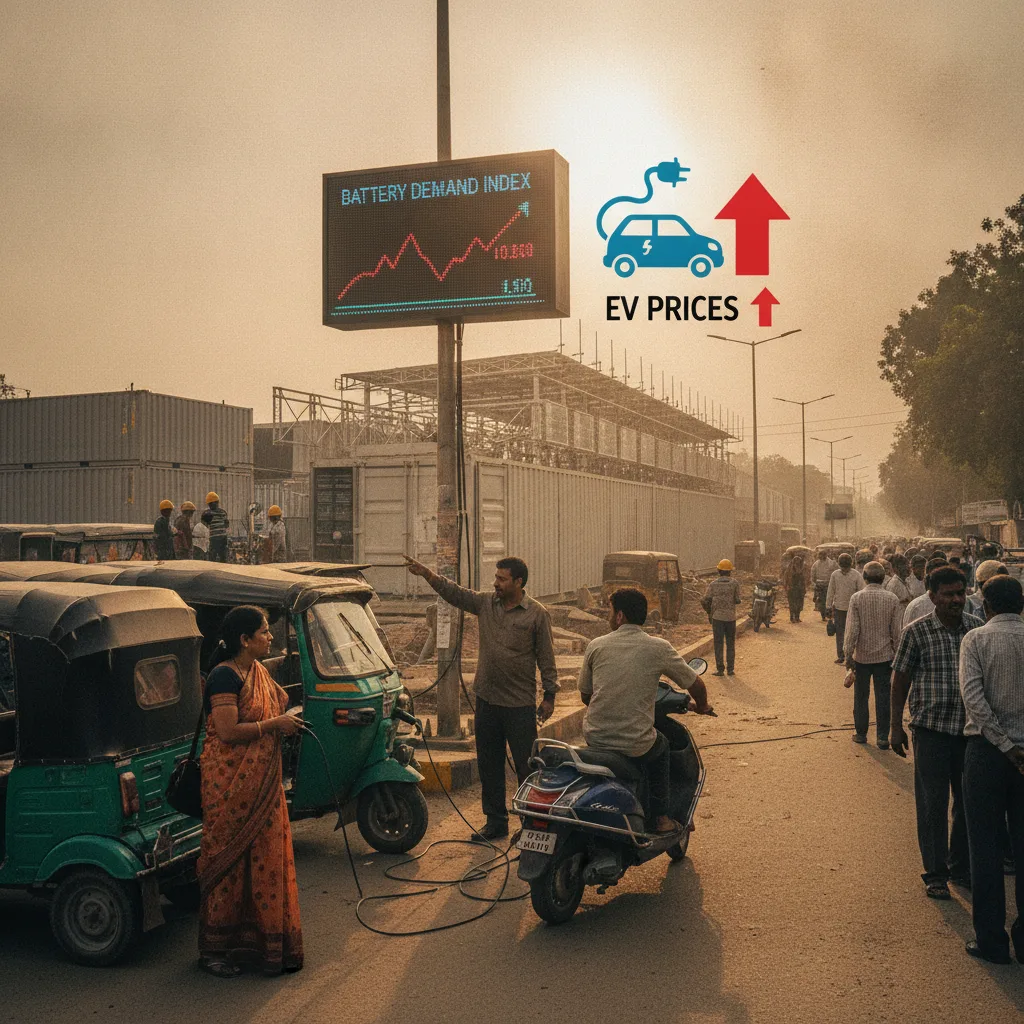
India's clean energy push is running into a quiet trade-off. The same lithium-ion cells that power electric vehicles are also the heart of big grid batteries, the battery energy storage systems, or BESS, that keep the lights on when the sun isn't shining and the wind isn't blowing. Now, as India ramps up its BESS targets, some analysts warn that surging demand for those cells could slow the price fall for EV batteries.
Down To Earth reported that India's BESS market is set to grow from almost nothing today to as much as 50 gigawatt-hours of annual demand by 2030. That is a huge jump. And every gigawatt-hour of BESS uses the same basic building block, a lithium-ion cell, as an electric car's battery pack.
The two markets share a single cost curve. When global cell production expands, both benefit. But if BESS demand eats up a big chunk of new factory output, EV makers may not see the price cuts they were banking on.
One cell, two buyers
India's solar and wind capacity has grown fast, but the grid still needs storage to handle the swings in generation. The government has set a target of 50 GWh of BESS by 2030 under its National Electricity Plan. At the same time, EV sales are climbing, the government wants 30 percent of new car sales to be electric by 2030.
Both goals lean on the same global supply chain. China dominates cell production today. India has almost no domestic cell manufacturing at scale, though a few factories are being built under the production-linked incentive scheme. Until those plants come online, India will import most of its cells.
A 2024 report from the Council on Energy, Environment and Water (CEEW) estimated that India's combined battery demand from EVs and BESS could hit 160 GWh per year by 2030. That is more than ten times the current global output of all Indian battery plants.
Cost pressures
Lithium-ion cell prices have fallen sharply over the past decade, from over $1,000 per kilowatt-hour in 2010 to around $130/kWh in 2023. But the rate of decline has slowed. Some analysts say that if BESS demand surges faster than expected, cell prices could stay flat or even rise in the short term.
That would hit EV prices directly. Batteries make up 30 to 40 percent of an electric car's cost. A 10 percent rise in cell prices could add ₹50,000 to ₹80,000 to the price of a mid-range EV in India.
There is a flip side. Big BESS orders can give cell makers the certainty they need to build bigger factories, which eventually lowers costs for everyone. The question is timing.
Policy choices ahead
The Indian government has tried to boost both markets at once. It offers subsidies for EV buyers under the FAME scheme and has announced a viability gap funding program for BESS projects. But it has not set aside a separate pool of cells for either sector.
Some industry experts argue that India should push for dedicated BESS chemistries, like sodium-ion or iron-air batteries, that do not compete with EV cells. Others say the country needs to build its own cell factories fast, so it can control supply rather than rely on imports.
For now, EV makers and BESS developers are watching the same price curve. What happens to one will ripple into the other.
Comments
Be the first to comment.
Leave a comment