India's EV retail sales hit 3.06 lakh units in June, driven by two-wheelers and three-wheelers
India's electric vehicle retail sales crossed 3.06 lakh units in June, with two-wheelers and three-wheelers leading the charge, according to data from the government's Vahan portal.
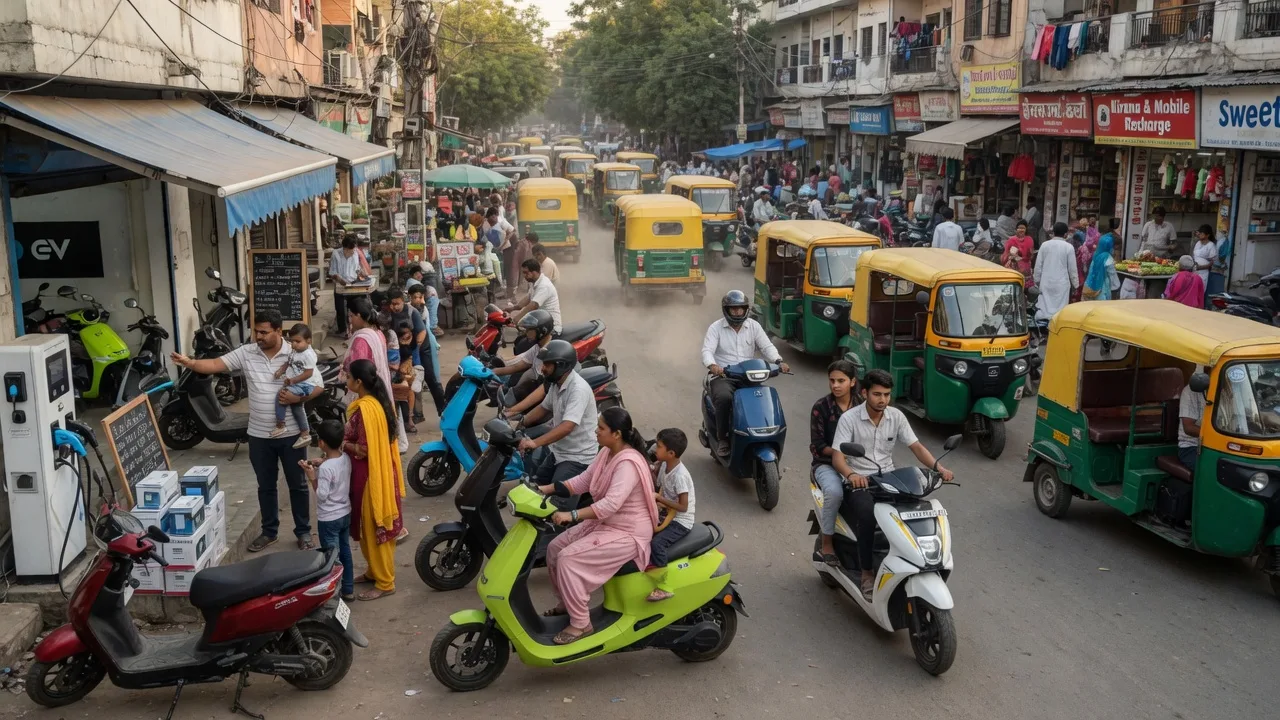
India's electric vehicle (EV) retail sales touched 3.06 lakh units in June, marking another month of strong growth across segments. The data, drawn from the government's Vahan portal, shows a sharp jump from May's 2.98 lakh units and a significant rise compared to 2.4 lakh units sold in June last year.
Two-wheelers and three-wheelers lead the pack
Two-wheelers continued to dominate the EV market, with 1.6 lakh units sold in June. That's up from 1.55 lakh in May and 1.2 lakh in June 2023. The segment now accounts for over half of all EV sales in the country.
Three-wheelers, which include e-rickshaws and cargo vehicles, posted 1.2 lakh units in June, up from 1.17 lakh in May. This segment has grown steadily as more cities push for last-mile delivery electrification.
Electric passenger vehicles, cars and SUVs, sold 9,200 units in June, slightly higher than May's 8,900 units. While still a small slice of the overall EV pie, the segment is gaining traction with new model launches and price cuts by manufacturers.
Electric buses saw 1,100 units sold in June, a marginal drop from May's 1,200 units. The segment remains dependent on state transport corporation orders and central government subsidies under the FAME-II scheme.
Policy push and market dynamics
The growth comes as the Indian government continues to push for EV adoption through the Faster Adoption and Manufacturing of Electric Vehicles (FAME-II) scheme, which offers subsidies on two-wheelers, three-wheelers, and buses. States like Maharashtra, Gujarat, Tamil Nadu, and Karnataka have also rolled out their own EV policies, offering additional incentives and lower road taxes.
In June, the Ministry of Heavy Industries extended the FAME-II scheme by three months, until September 30, 2024. The move gave manufacturers and buyers breathing room as the government works on a successor policy, FAME-III.
On the supply side, companies like Ola Electric, Ather Energy, Bajaj Auto, and TVS Motor have ramped up production and expanded their dealer networks. Ola Electric alone sold over 35,000 units in June, keeping its lead in the two-wheeler segment. Newer players like Greaves Electric and Ampere have also pushed volumes, offering affordable models aimed at daily commuters.
Challenges remain
Despite the upbeat numbers, the EV market faces hurdles. Charging infrastructure remains patchy, especially in smaller towns and along highways. The government's FAME-II subsidy for two-wheelers was slashed in June 2023, forcing manufacturers to raise prices. That led to a dip in sales last year, but volumes have since recovered as companies absorbed some of the costs and launched cheaper models.
Battery costs, which account for 30-40% of an EV's price, have also eased. Lithium-ion battery prices fell by roughly 14% in 2023, according to BloombergNEF, helping manufacturers keep prices competitive.
Another issue: financing. Banks and non-banking financial companies (NBFCs) remain cautious about lending to EV buyers, citing concerns over resale value and battery life. Industry bodies have urged the government to set up a credit guarantee scheme to ease financing.
What the numbers signal
The June data shows that EV adoption is no longer just a metro-city trend. Tier-2 and tier-3 cities like Lucknow, Patna, Indore, and Coimbatore are reporting rising registrations. In Uttar Pradesh, EV registrations crossed 1.5 lakh in the first half of 2024, driven largely by e-rickshaws and low-speed two-wheelers.
Overall, India's EV penetration across all vehicle segments now stands at around 6.5%, up from 4.5% a year ago. Two-wheelers lead with 7.2% penetration, followed by three-wheelers at 12%, passenger vehicles at 2.4%, and buses at 3.8%.
Industry analysts expect monthly sales to cross 3.5 lakh units by September, driven by the festive season and the FAME-II extension. But much depends on how quickly the government rolls out FAME-III and whether states continue their supportive policies.
For now, the numbers tell a clear story: India's EV market is moving from early adopters to mass adoption, one scooter and e-rickshaw at a time.
Comments
Be the first to comment.
Leave a comment