
India's solar boom hits speed bumps: regional gaps, factory glut
A new analysis shows solar capacity is piling up in a few states while factories run below half their output, threatening the country's 2030 clean-energy target.
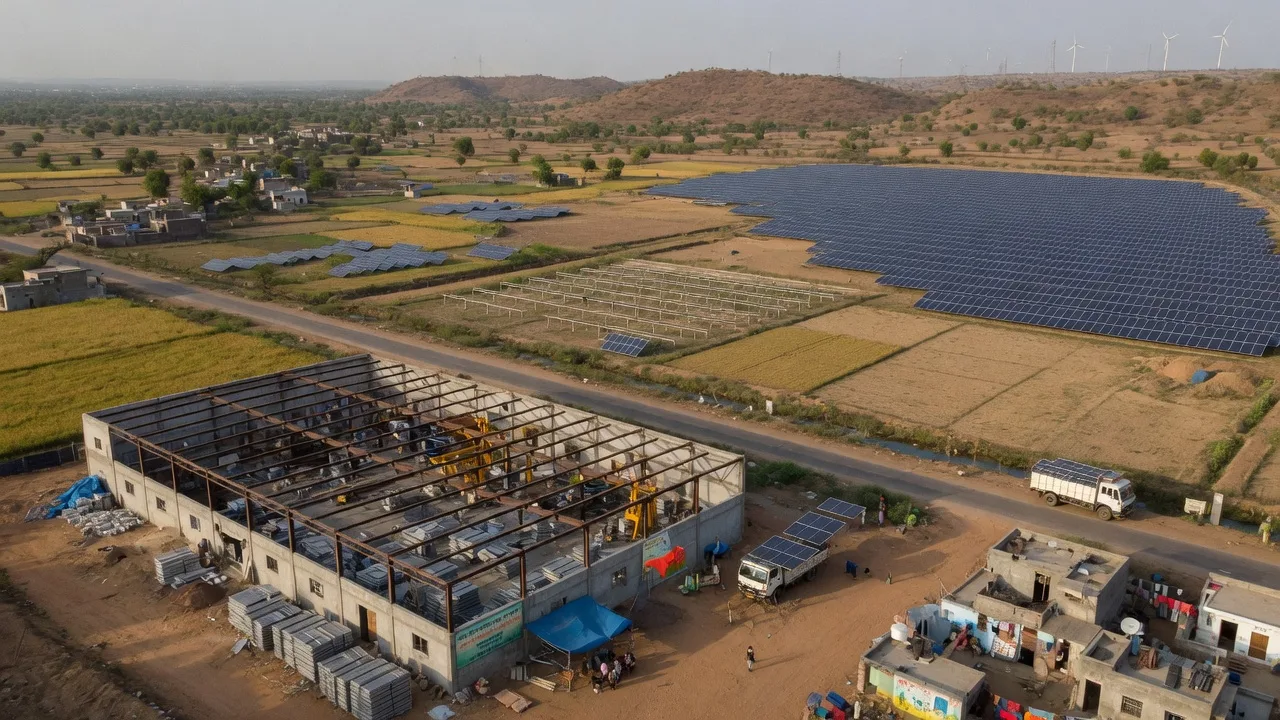
India's solar power boom is running into two stubborn problems. The first is a regional imbalance, most new capacity is being built in just three or four states. The second is a manufacturing glut: factories can make far more solar panels than the country can buy.
Together, these issues could slow the country's push to reach 500 GW of non-fossil fuel capacity by 2030. That target was set by the government to cut emissions and meet rising electricity demand.
Where the sun shines, and where it doesn't
Rajasthan, Gujarat, Karnataka, and Tamil Nadu account for the bulk of India's installed solar capacity. States in the east and northeast, by contrast, have barely started. The imbalance is not new, but it is getting worse.
The central government has tried to fix this with schemes that offer cheaper power from solar plants built in less sunny states. But state-level policies often get in the way. Some states have high open-access charges or strict net-metering rules that make rooftop solar less attractive. Others simply lack the grid infrastructure to handle large solar farms.
Industry experts say the problem is not a lack of interest. It is a mismatch between where the sun shines brightest and where the power is needed most. Northern and western states have plenty of land and high solar radiation. Eastern states, which depend heavily on coal, have less land and weaker grids.
Too many panels, too few buyers
On the manufacturing side, the picture is equally lopsided. India's solar panel factories can now produce more than 50 GW of modules a year. But annual installations have stayed below 15 GW. That leaves a huge gap between what factories can make and what the market can absorb.
The government has tried to protect domestic makers by slapping a 40% import duty on solar modules and a 25% duty on cells. It also runs a production-linked incentive (PLI) scheme worth billions of dollars to push local manufacturing. But the policy has had an odd side effect: cheap Chinese panels are still flooding in through loopholes, undercutting Indian factories.
At the same time, many Indian manufacturers are struggling to find buyers. Tenders for large solar projects have slowed down. Distribution companies, already deep in debt, are reluctant to sign new power-purchase agreements. Rooftop solar, which the government had hoped would drive demand, has grown far more slowly than expected.
Glut meets policy drift
The manufacturing glut is not just about numbers. It is also about quality. Many Indian factories make older, less efficient panel designs. Buyers, both Indian and foreign, prefer the latest high-efficiency modules, which are still mostly made in China. So even as Indian factories sit idle, the country imports billions of dollars worth of cells and modules every year.
Some manufacturers have cut prices to stay afloat. Others have scaled back production. A few have delayed expansion plans. The PLI scheme requires winners to set up fully integrated plants, from ingot to module, but those plants take years to build. In the meantime, the gap between capacity and demand keeps growing.
For India to hit its 2030 target, both problems need fixing. The regional imbalance calls for better grid planning and state-level reforms. The manufacturing glut needs either stronger demand or a sharper focus on making the kind of panels the market actually wants. So far, neither fix has come fast enough.
Comments
Be the first to comment.
Leave a comment