
Why India's clean energy problem is moving power, not making it
India has added record amounts of solar and wind capacity, but the grid cannot move that electricity from sunny states to power-hungry cities, threatening the country's 2030 targets.
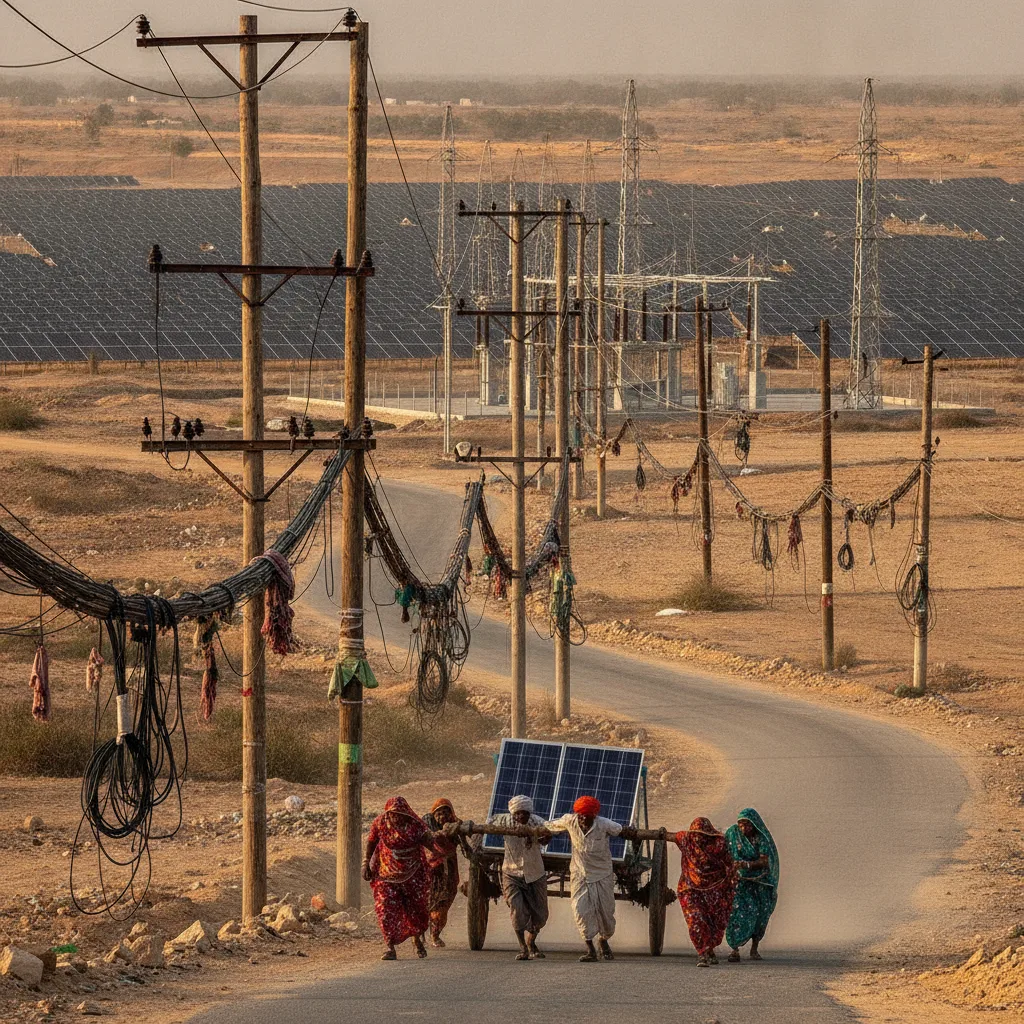
NEW DELHI, India's clean energy push has hit a new bottleneck. The country is building solar and wind farms at a record pace. But it cannot get the power where it is needed.
The grid is the problem. Transmission lines are too few, too slow to build, and stretched thin. The result: renewable energy is being wasted, even as millions of people face power cuts during heatwaves.
Generation is no longer the issue
India added 18.5 gigawatts of solar capacity in 2023-24, a jump of nearly 30% from the year before. Wind installations also picked up. The government says total renewable capacity will hit 500 GW by 2030.
But generation is only half the story. The sunniest states, Rajasthan, Gujarat, Karnataka, are far from the big cities that need power. Delhi, Mumbai, and Bengaluru depend on coal plants nearby. To run on solar, they need long-distance transmission lines that do not yet exist.
"The challenge has shifted from building capacity to building connectivity," said a senior official at the Ministry of Power, speaking on condition of anonymity because he was not authorized to talk to the press.
Transmission is falling behind
The government's own data shows the problem. India needs to add about 50,000 circuit kilometers of transmission lines by 2030 to meet its renewable targets. As of March 2024, it had built less than half of that.
Land acquisition is the biggest hurdle. Farmers in Rajasthan and Madhya Pradesh have resisted giving up land for towers and cables. Court cases drag on for years. State governments, which control land records, often move slowly.
Another issue: the grid is not designed for variable power. Solar stops flowing after sunset. Wind dies down without warning. Grid operators must balance supply and demand second by second. Without enough transmission lines to move power across regions, they are forced to cut renewable output to keep the system stable.
In 2023, India curtailed, or deliberately wasted, about 8 billion units of renewable electricity, enough to power 2 million homes for a year.
Money is tight
Building transmission lines costs money. The central transmission utility, Power Grid Corporation of India, has a capital spending plan of about ₹2.5 lakh crore ($30 billion) for the next five years. But private investors are wary. Returns on transmission projects are low compared to generation. Delays eat into profits.
The government has tried to speed things up. In 2022, it launched a scheme to build "green energy corridors", dedicated transmission lines from renewable zones to load centers. But only one of the eight planned corridors is fully operational.
State-owned companies are also stretched. Discoms, the state electricity distribution companies, are already losing money. They owe generators ₹1.2 lakh crore ($14.5 billion) in unpaid bills. Investing in new transmission lines is not their priority.
What happens next
India aims to get 50% of its electricity from non-fossil sources by 2030. It is on track for generation capacity. But without transmission, that capacity is meaningless.
The Ministry of Power has set up a task force to identify bottlenecks. It is pushing states to fast-track land acquisition. It is also testing new technology, high-voltage direct current lines that can move power over long distances with less loss.
But the pace of change is slow. "We are building transmission at half the speed we need," said the Power Ministry official. "If we don't fix this, we will not meet our 2030 goal."
Comments
Be the first to comment.
Leave a comment