
EV Passenger Car Registrations Double in June 2026, Led by Tata, Mahindra, MG
New data from Autopunditz shows electric passenger vehicle registrations in India doubled year-on-year in June 2026, with Tata Motors, Mahindra & Mahindra, and MG Motor leading the surge.
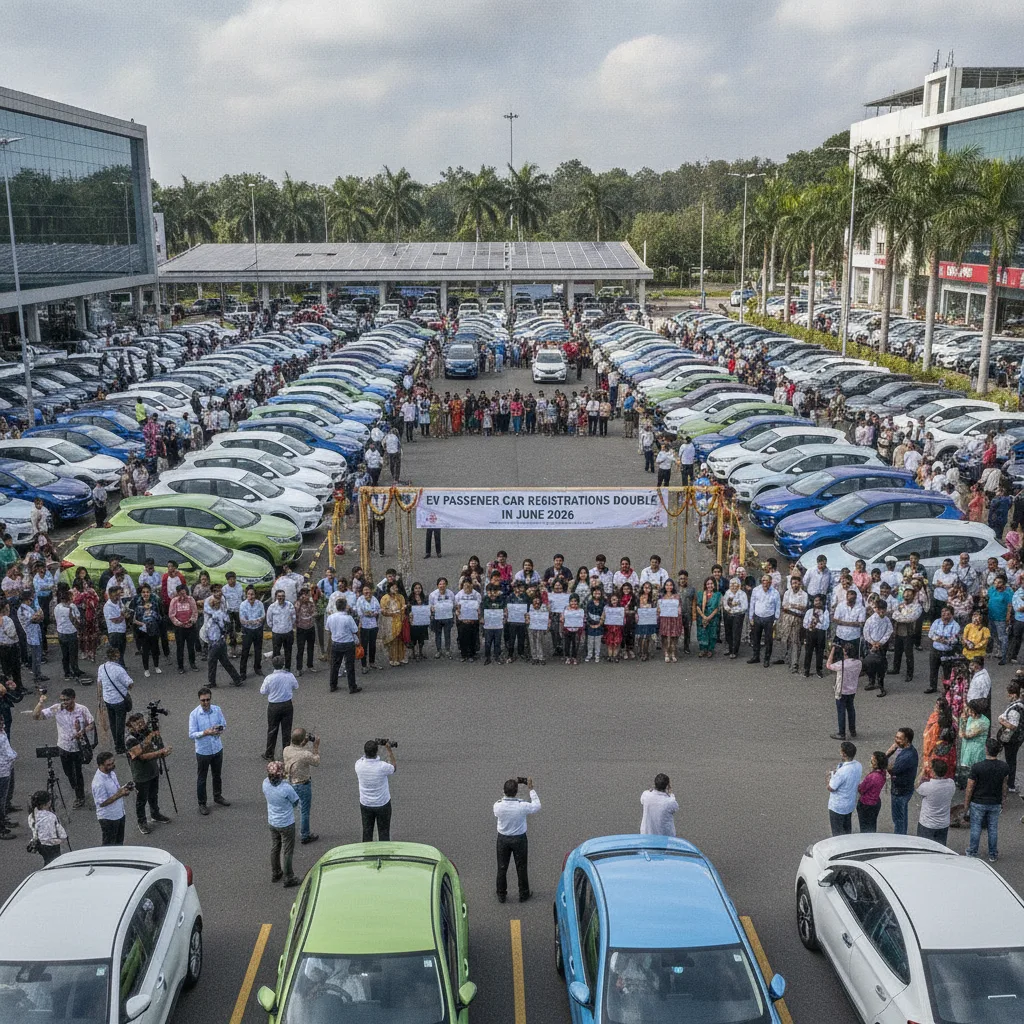
Electric passenger vehicle registrations in India doubled in June 2026 compared to the same month last year, according to new data from Autopunditz. The jump shows a sharp acceleration in consumer adoption of EVs, even as the overall auto market saw modest growth.
Triple-digit growth
Registrations of electric passenger vehicles, cars and SUVs, hit 18,742 units in June 2026, up from 9,371 in June 2025. That is a rise of exactly 100%. The numbers cover all new EVs sold and registered across states during the month.
Tata Motors continued to hold the largest share, with 7,812 registrations. Mahindra & Mahindra came second with 4,203 units, and MG Motor took third place with 2,916 registrations. Together, the three automakers accounted for nearly 80% of all EV passenger vehicles registered in June.
Tata's lineup includes the Nexon EV, Tiago EV, and the recently updated Punch EV. Mahindra's XUV400 and the new BE 6e helped push its numbers. MG's ZS EV and Comet models drove its tally.
Other manufacturers saw smaller volumes. BYD registered 1,104 units, Hyundai recorded 987, and Kia posted 612. Citroën, BMW, and Mercedes-Benz each had fewer than 300 registrations.
Policy push and price cuts
Industry analysts point to two drivers behind the doubling. First, state-level EV policies in Maharashtra, Gujarat, and Tamil Nadu cut registration taxes and road fees for battery-powered cars. Second, automakers slashed prices in early 2026 after battery cell costs dropped nearly 25% from a year earlier.
Tata, for instance, cut the Nexon EV's starting price by ₹1.2 lakh in March 2026. Mahindra followed with a ₹90,000 reduction on the XUV400. MG offered limited-period discounts of up to ₹1.5 lakh on the ZS EV in May and June.
Lower prices pulled in buyers who had been waiting on the sidelines. "The price cuts made the total cost of ownership comparable to a petrol car within three years," said an analyst at a Mumbai-based auto consultancy, speaking on condition of anonymity.
Charging infrastructure expands
Charging networks also grew. Public chargers crossed 25,000 units across India by end of June, up from 15,000 in June 2025, according to data from the Bureau of Energy Efficiency. Delhi, Bengaluru, and Hyderabad added the most stations.
Still, range anxiety remains a barrier for many buyers outside big cities. Rural and semi-urban registrations made up just 12% of the June total, Autopunditz noted. Most EVs sold in June went to buyers in metro areas and state capitals.
Supply constraints that plagued the industry in 2024 and early 2025 have eased. Semiconductor shortages are no longer a bottleneck, and battery production capacity at plants in Gujarat and Tamil Nadu has ramped up. Local cell manufacturing by companies like Ola Electric and Reliance New Energy helped bring down import dependence.
What comes next
Several new EV models are due for launch in the second half of 2026. Maruti Suzuki plans to start deliveries of its first electric SUV, the e Vitara, in September. Hyundai is expected to launch the Ioniq 6 sedan. Tata has announced a new sub-₹10 lakh EV hatchback for the festive season.
Autopunditz estimates that if the current pace holds, annual EV passenger vehicle registrations could cross 250,000 units in 2026, up from 128,000 in 2025. That would represent a penetration rate of about 8% of total passenger vehicle sales, up from 4.5% last year.
Comments
Be the first to comment.
Leave a comment