
IIT Madras students build solar-powered EV for Indian roads
A student team at IIT Madras has designed and built a solar-assisted electric three-wheeler, aiming to cut charging needs and push clean mobility in India.
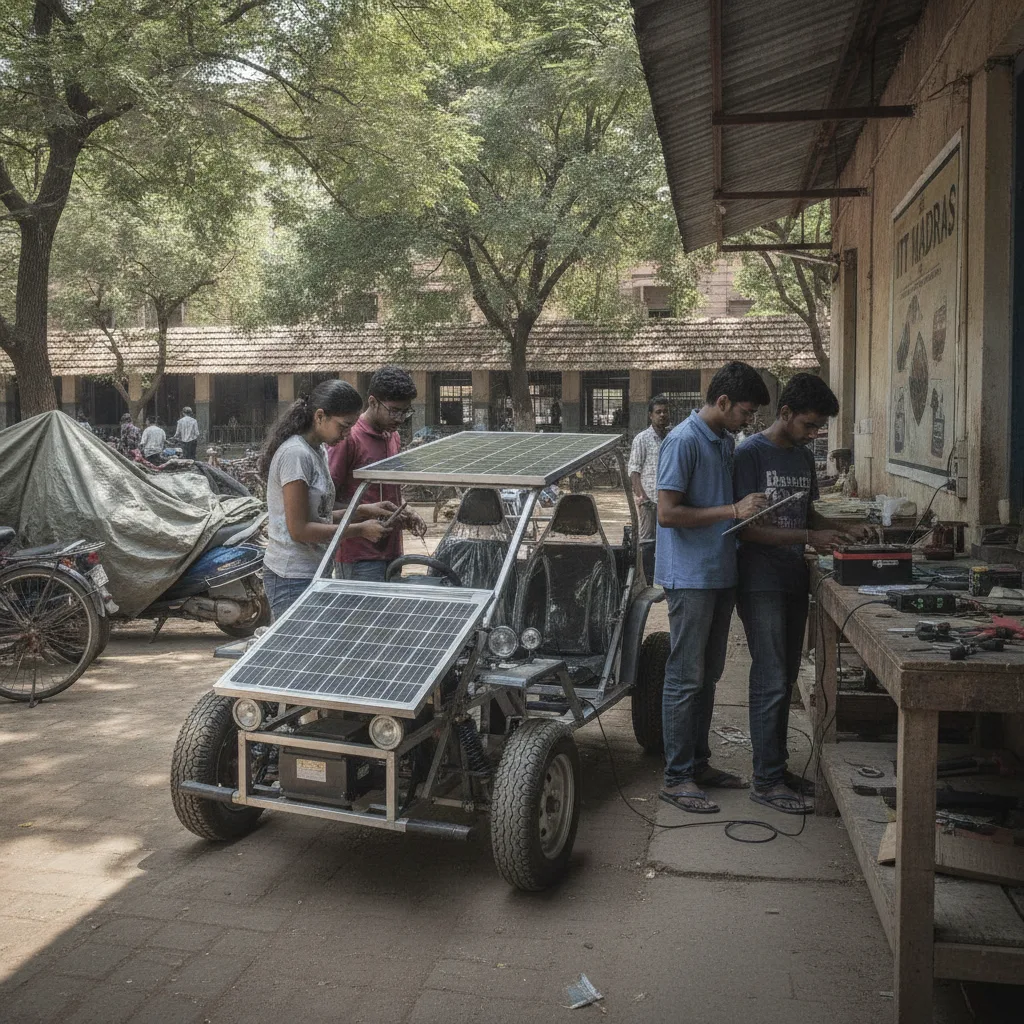
CHENNAI, A group of students at the Indian Institute of Technology Madras is trying to change how India thinks about solar mobility. They have built a solar-assisted electric three-wheeler, a vehicle that uses sunlight to help power its battery.
The project, run by the institute's Centre for Innovation, started in early 2023. Around 20 students from different engineering streams, mechanical, electrical, and design, worked on it. They wanted to see if a small, affordable vehicle could run partly on solar energy, cutting down the need for grid charging.
The vehicle looks like a standard auto-rickshaw but carries solar panels on its roof. These panels feed electricity into the battery while the vehicle moves or sits parked. The team says the setup can add up to 30 kilometers of range per day under good sunlight. For a vehicle that travels 60, 70 kilometers daily, that means half the charging load disappears.
"We wanted to show that solar can be a practical add-on, not just a gimmick," said one of the student leads, who asked not to be named because the project is still in testing. The team has run road trials around the IIT Madras campus for four months. They tracked battery levels, solar input, and driving patterns. Early data shows the panels cover about 40 percent of the daily energy need on clear days.
Low-cost parts, big ambition
The students kept costs low. They used off-the-shelf solar panels and a standard lithium-ion battery pack. The motor and controller come from a local EV parts supplier in Chennai. Total material cost came to about ₹1.5 lakh, roughly $1,800. That is far less than most solar EV prototypes, which often use custom parts.
The team is now talking to an auto-rickshaw manufacturer in Coimbatore about taking the design to the next stage. They want to build five more test vehicles and run them on real routes, markets, railway stations, and residential areas, for six months. If that works, they hope the company will look at a small production run.
"The idea is not to replace the grid but to reduce its load," said a faculty advisor at the centre. "If every three-wheeler in Chennai saved 30 kilometers of charging a day, the city would need fewer charging stations. That saves money and land."
India has more than 7 million three-wheelers on its roads, most running on petrol or CNG. The government wants 80 percent of new three-wheeler sales to be electric by 2030. But charging infrastructure remains patchy, especially in smaller towns. Solar-assisted vehicles could help bridge that gap.
The IIT Madras team is not alone. Other institutes, IIT Bombay, IIT Kanpur, and Vellore Institute of Technology, have built solar EV prototypes in the past two years. But the Madras team says its focus on low cost and simple parts makes it different.
"We are not building a spaceship. We are building something a driver in Madurai can afford and fix," the student lead said.
The team plans to publish its full test results in an open-access journal by mid-2025. They also want to share the design files online so anyone, a garage owner, a college club, a small manufacturer, can build their own version.
For now, the vehicle sits under a tree near the centre's workshop. Students check the battery every morning. On a recent sunny day, the panels had already pushed the charge from 60 percent to 78 percent by 10 a.m. The driver for that day's test run grinned. "Free fuel," he said.
Comments
Be the first to comment.
Leave a comment