
India EV registrations surge 89% in Q2 2024 as Tata leads charge
Retail registrations of electric cars in India jumped 89% year-on-year in the April-June quarter, driven by new model launches and wider dealer networks.
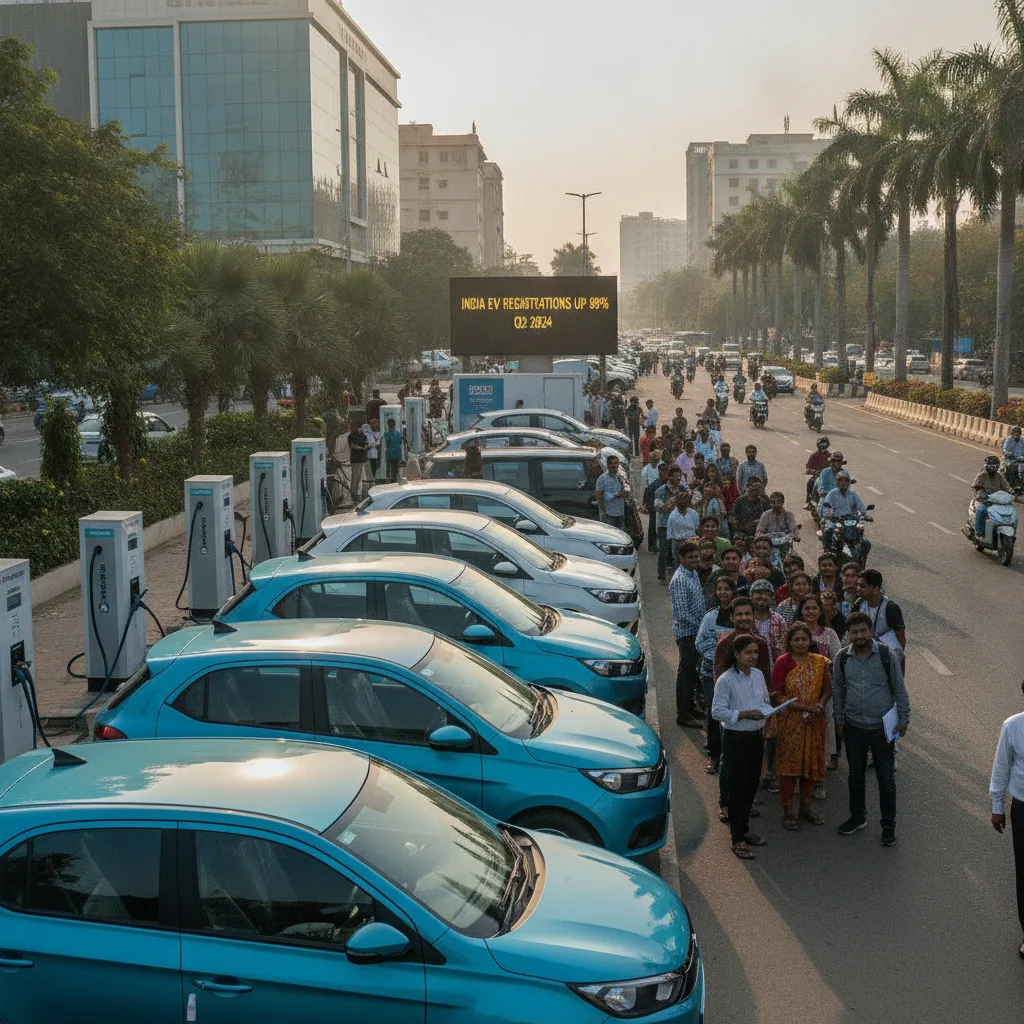
India's electric car market is charging ahead. Retail registrations of battery-powered passenger vehicles rose 89% in the April-June quarter compared to the same period last year, according to data from the Vahan portal compiled by BusinessLine.
A total of 22,138 electric cars were registered in the three-month period, up from 11,708 units in Q2 2023. The jump marks the highest quarterly growth rate in over a year.
Tata Motors stays on top
Tata Motors continued to dominate the segment. The company accounted for 14,873 registrations, roughly 67% of the total market. Its Tiago.ev and Nexon.ev models remain the top-selling electric cars in the country.
MG Motor India came second with 2,270 registrations, helped by the ZS EV and the newly launched Comet. Mahindra & Mahindra followed with 1,621 units, largely from its XUV400 model.
BYD India posted 1,002 registrations, while Citroën registered 583 units of its eC3. Other players, including Hyundai and Kia, accounted for the remaining volumes.
New models, wider reach
Industry analysts point to two key drivers. First, the number of electric car models available in India has doubled over the past year. Buyers now have more than 15 options across price points, from entry-level city cars to premium SUVs.
Second, automakers have expanded their sales and service networks. Tata Motors alone added over 100 new EV dealerships in the last 12 months. MG and Mahindra have also widened their presence beyond metro cities.
"The growth is coming from both repeat buyers and first-time EV owners," said an auto analyst tracking the sector. "Lower running costs and government incentives are pulling in more customers."
Policy push and price cuts
The central government's Faster Adoption and Manufacturing of Electric Vehicles (FAME II) scheme continues to provide upfront discounts on electric cars. Several states, including Delhi, Maharashtra, Gujarat, and Karnataka, offer additional road tax exemptions and registration fee waivers.
Battery prices have also softened. Lithium-ion cell costs fell roughly 14% over the past year, allowing automakers to cut retail prices. Tata Motors reduced the Tiago.ev's price by up to ₹70,000 in early 2024. MG slashed the Comet's sticker price by ₹1 lakh.
Lower prices are bringing electric cars closer to their petrol counterparts. The Tiago.ev now starts at ₹7.99 lakh (ex-showroom), while the entry-level petrol Tiago starts at ₹5.99 lakh. The gap has narrowed significantly from two years ago.
Charging infrastructure still a bottleneck
Despite the sales surge, charging infrastructure remains patchy. India has roughly 12,000 public charging points, according to government data. That is one charger for every 50 electric cars on the road, far below the global benchmark of one per 10 vehicles.
Range anxiety continues to deter many potential buyers. Most mass-market electric cars offer a real-world range of 200-300 km per charge, which limits their use to city commutes and short highway trips.
"The charging network is growing, but not fast enough to match sales," said a dealer from Bengaluru. "Customers in apartment complexes still struggle to get chargers installed."
What the numbers mean
Electric cars still represent a tiny slice of India's overall passenger vehicle market. In the April-June quarter, total passenger car sales stood at roughly 9.8 lakh units. EVs made up just 2.3% of that.
But the trajectory is clear. At the current growth rate, electric car registrations could cross 1 lakh units for the full calendar year 2024, double the 50,000 units sold in 2023.
"We are at an inflection point," the analyst said. "If infrastructure keeps pace, the next two years could see electric cars hit 5% of total sales."
Comments
Be the first to comment.
Leave a comment