India pushes electric vehicles to slash oil import bill
A new government push for electric vehicles aims to reduce India's dependence on imported crude oil, which costs the country billions each year.
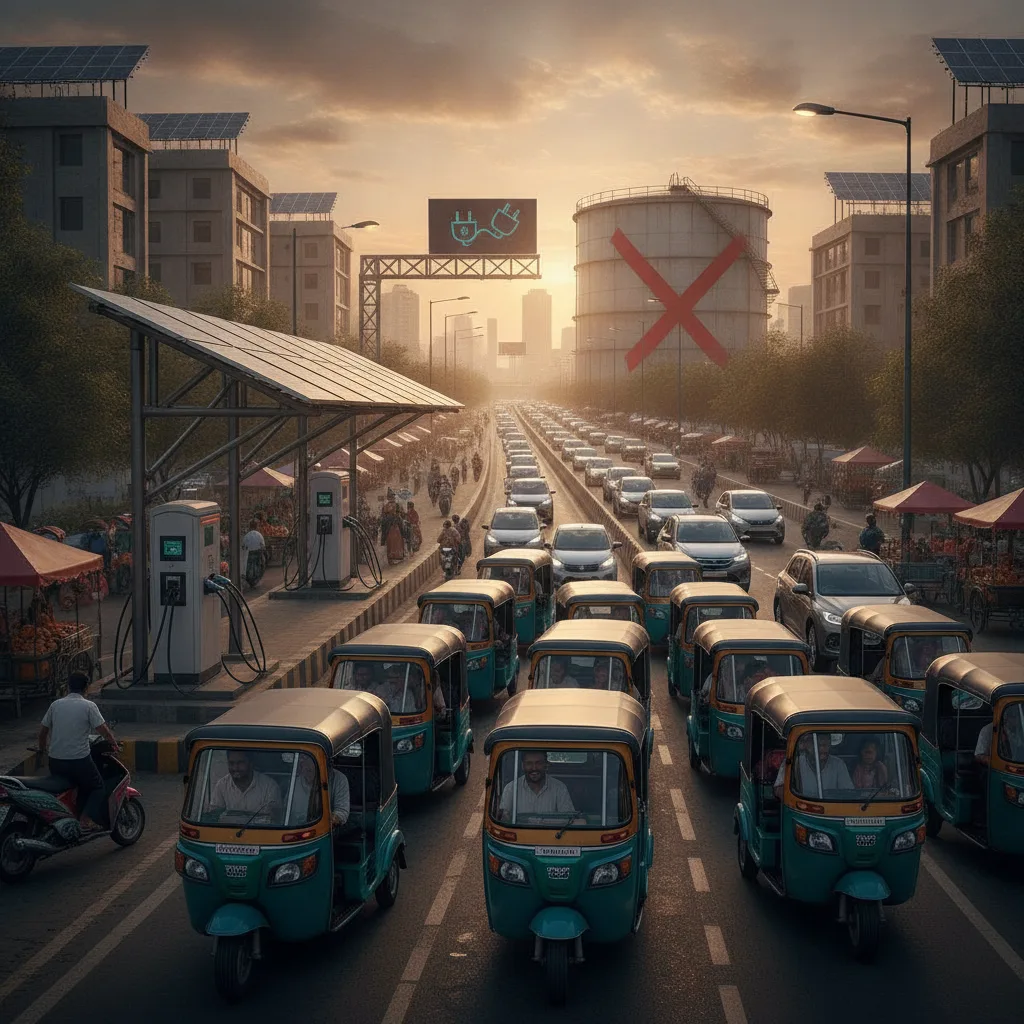
The Indian government is stepping up efforts to promote electric vehicles as a way to cut the country's massive oil import bill. Officials say the move could save billions of dollars and help meet climate goals.
India imports about 85 percent of its crude oil needs. That bill hit $119 billion in the last fiscal year. Transport accounts for a large share of oil demand, roughly 40 percent of all petroleum products consumed in the country go into vehicles.
Why EVs matter for oil savings
Switching to electric vehicles reduces the need for petrol and diesel. Each EV on the road directly replaces oil consumption. The government estimates that widespread EV adoption could cut oil imports by up to 156 million barrels a year by 2030. That would save around $14 billion at current prices.
The push comes as global oil prices remain volatile. A sharp spike in 2022 pushed India's import bill to record levels. Finance ministry officials have said that reducing oil dependence is a strategic priority.
Current EV adoption in India
EV sales in India are growing but still small. In 2023, electric vehicles made up about 6 percent of total auto sales. Most of those were two-wheelers and three-wheelers. Electric car sales remain low, less than 2 percent of the passenger vehicle market.
The government has set a target of 30 percent EV sales by 2030 for private cars, 70 percent for commercial vehicles, and 80 percent for two- and three-wheelers. Reaching those goals would require a big jump in charging infrastructure and battery manufacturing.
Policy measures so far
New Delhi has rolled out several schemes to boost EV adoption. The Faster Adoption and Manufacturing of Electric Vehicles program, or FAME II, provides subsidies for buyers. The government has also lowered GST on EVs to 5 percent, compared with 28 percent for petrol and diesel cars.
State governments are joining in. Delhi, Maharashtra, Gujarat, and Karnataka offer extra incentives. Some states waive road tax and registration fees for EVs. Others are building public charging stations.
Challenges remain
High upfront cost is still a barrier. Electric cars cost 30 to 40 percent more than petrol models. Battery prices have fallen sharply over the past decade but remain a big chunk of the total cost.
Charging infrastructure is another problem. India has about 12,000 public charging stations, mostly in big cities. Rural areas have very few. Range anxiety keeps many buyers away.
Battery manufacturing is also a concern. Most lithium-ion cells are imported from China. The government is offering production-linked incentives to build domestic battery plants. But those factories will take years to come online.
Oil imports and the bigger picture
Cutting oil imports is not just about money. It is also about energy security. India's oil comes mainly from the Middle East. Any disruption in that region can hit the economy hard.
Transport minister Nitin Gadkari has said that India spends more on oil imports than on education and health combined. He has called EVs a way to turn that around. "We need to move to alternative fuels," he said in a recent speech. "Electric vehicles are the future."
The government is also looking at ethanol blending and hydrogen fuel cells. But for now, EVs are the main focus. The next few years will show whether the push is enough to shift India's transport sector away from oil.
Comments
Be the first to comment.
Leave a comment