
India ranks among world's cheapest major solar power markets
New data shows India's solar tariffs have fallen to among the lowest globally, driven by scale, competitive auctions, and falling component costs.
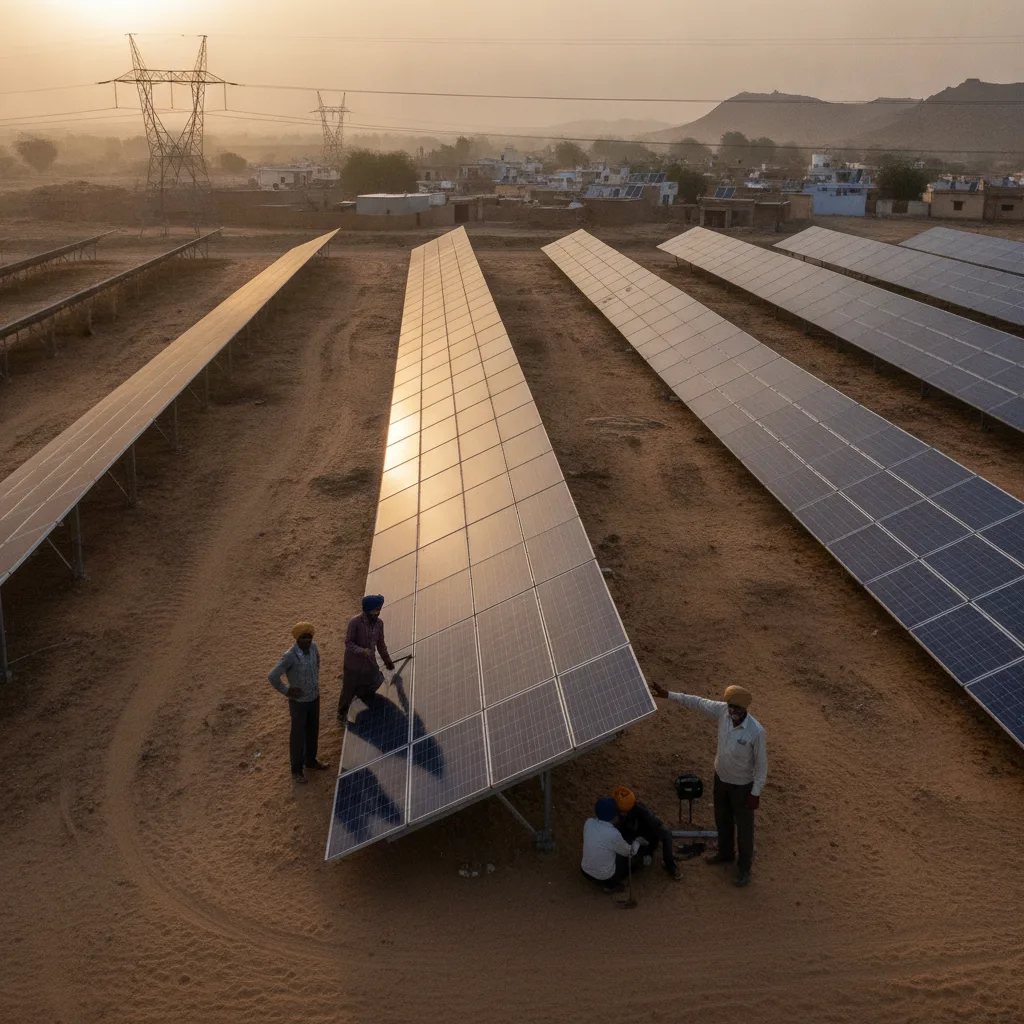
India has emerged as one of the lowest-cost major solar power markets in the world, according to a recent report. The country now offers some of the cheapest solar tariffs anywhere, beating many developed and developing nations.
Data from the International Renewable Energy Agency and industry trackers show that India's large-scale solar projects routinely win bids at tariffs below 2.50 rupees per kilowatt-hour. That is roughly 3.3 cents. Only a handful of countries, mostly in the Middle East and parts of China, can match those numbers.
The low prices come from a mix of factors. India has built a huge pipeline of solar farms. The government's push for competitive reverse auctions has forced developers to cut costs. At the same time, global prices for solar panels and inverters have fallen sharply over the past decade.
Scale and competition drive down costs
India added about 13 gigawatts of solar capacity in the 2022-23 financial year. Total installed solar capacity now stands at more than 70 GW. That scale lets developers buy equipment in bulk and spread fixed costs over many projects.
State-run agencies like the Solar Energy Corporation of India run large tenders. Private companies also bid aggressively. The result: tariffs that dropped from over 4 rupees per unit in 2017 to below 2 rupees in some recent auctions.
But the low prices come with risks. Some winning bids are so tight that developers may struggle to make money if panel prices rise or if grid delays push back project deadlines. A few projects have been delayed because of land acquisition problems or transmission bottlenecks.
Global context
Compared to other big solar markets, India looks cheap. The average cost of utility-scale solar in the United States is around 4.5 cents per kilowatt-hour. In Germany it is above 6 cents. Even China, the world's largest solar market, has average tariffs slightly above India's in some regions.
India's advantage comes partly from low labor costs and cheap financing from state banks. But the country still pays more for capital than richer nations. Interest rates on solar loans in India run 8 to 10 percent, while in Europe or the US they can be half that.
Solar panel manufacturing is another story. India imports most of its cells and modules from China. The government has tried to boost local production with tariffs and production-linked incentives, but domestic factories still cannot match Chinese prices.
Policy and grid challenges
The central government has set a target of 500 GW of renewable energy capacity by 2030. Solar is meant to provide the bulk of that, around 280 GW. Reaching that goal means adding roughly 30 GW of solar every year for the next seven years.
That pace is possible but not easy. The power grid needs upgrades to handle variable solar output. States must speed up land approvals. And distribution companies, which buy the power, are often in weak financial health. They sometimes delay payments to generators, which raises risks and costs.
Despite those hurdles, India's solar story remains one of the world's most remarkable. The country has gone from almost no solar a decade ago to a top-five global market. And it has done so while keeping prices among the lowest anywhere.
"India's solar tariffs are now competitive with coal-fired power in many states," said a senior analyst at the Institute for Energy Economics and Financial Analysis. "That changes the economics of the entire power sector."
Comments
Be the first to comment.
Leave a comment