
India’s $100 Billion Grid Bet Drives Solar Manufacturing Surge
A massive push to modernise India's power grid is sparking a rapid expansion of domestic solar panel and cell production, reshaping the country's energy landscape.
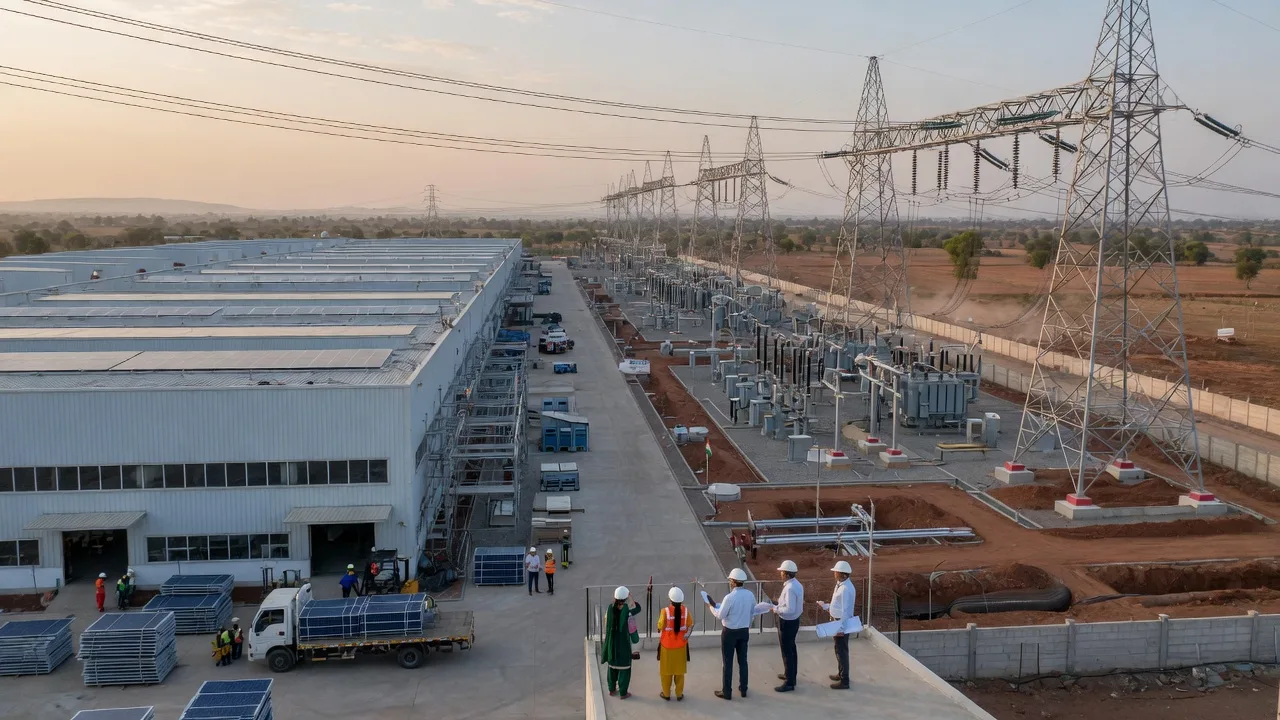
NEW DELHI, India is spending $100 billion to overhaul its creaking power grid. That bet is now feeding a boom in solar manufacturing that could turn the country into a global export hub.
The government's grid-modernisation plan, known as the Green Energy Corridor and backed by state-owned Power Grid Corporation, aims to carry more renewable power from sunny western states like Rajasthan and Gujarat to high-demand cities in the north and east. Work is underway on high-voltage transmission lines, substations, and battery storage projects.
But the grid push is only half the story. To meet its 2030 target of 500 gigawatts of non-fossil fuel capacity, India needs solar panels, lots of them. And it wants to make them at home.
Factories rise on policy support
Since 2020, India has slapped a 40% import duty on solar modules and a 25% duty on cells. It also launched a production-linked incentive (PLI) scheme worth about $2.5 billion for solar manufacturing. The results are showing up fast.
Waaree Energies, India's largest solar panel maker, opened a new 5 gigawatt factory in Gujarat last year. Adani Solar is building a fully integrated plant in Mundra that will turn raw silicon into finished panels, a first for the country. Reliance Industries is spending $10 billion on a solar giga-factory in Jamnagar, which will also make batteries and electrolysers.
"This is a structural shift," said Vinay Rustagi, managing director of renewable-energy research firm Bridge to India. "India is moving from being a net importer to a potential exporter of solar equipment."
Bloomberg NEF estimates India's solar manufacturing capacity will hit 60 GW by 2025, up from 15 GW in 2022. That would make it the world's second-largest producer after China.
Grid bottlenecks remain
The boom is not without risk. India's grid is old and weak. Blackouts are common in many states. The $100 billion upgrade will take years to finish, and delays could leave new solar plants stranded.
"You can build all the panels you want, but if you can't move the power to where it's needed, the investment is wasted," said Kameswara Rao, a partner at consulting firm KPMG India.
Another problem is money. State-owned distribution companies, which buy power from solar farms, are deep in debt. They owe generators billions of dollars. The central government has tied some grid funding to reforms in state power utilities, but progress is patchy.
China still dominates supply chains
India's solar push also faces a China challenge. Beijing controls nearly 80% of the global supply of polysilicon, the raw material for solar cells. Indian makers still import most of their polysilicon from China, leaving them exposed to price swings and trade tensions.
"We are building assembly lines, not a complete supply chain," said a senior executive at a Mumbai-based solar firm who asked not to be named. "True self-reliance will take another five to seven years."
The government is offering incentives for polysilicon and wafer production, but no major project has broken ground yet.
Exports on the horizon
Despite the hurdles, Indian solar makers are already looking abroad. Waaree Energies has signed deals to supply panels to the United States and Europe. Adani Solar is targeting the Middle East and Africa.
"We see strong demand from markets that want to reduce dependence on China," said Sunil Rathi, director of Waaree Energies. "India can fill that gap if we keep building quality and scale."
Comments
Be the first to comment.
Leave a comment