
Solar project in India's largest grassland stirs conservation fears
A proposed solar plant in Gujarat's Banni grassland could disrupt local wildlife and traditional livelihoods, scientists and pastoralists warn.
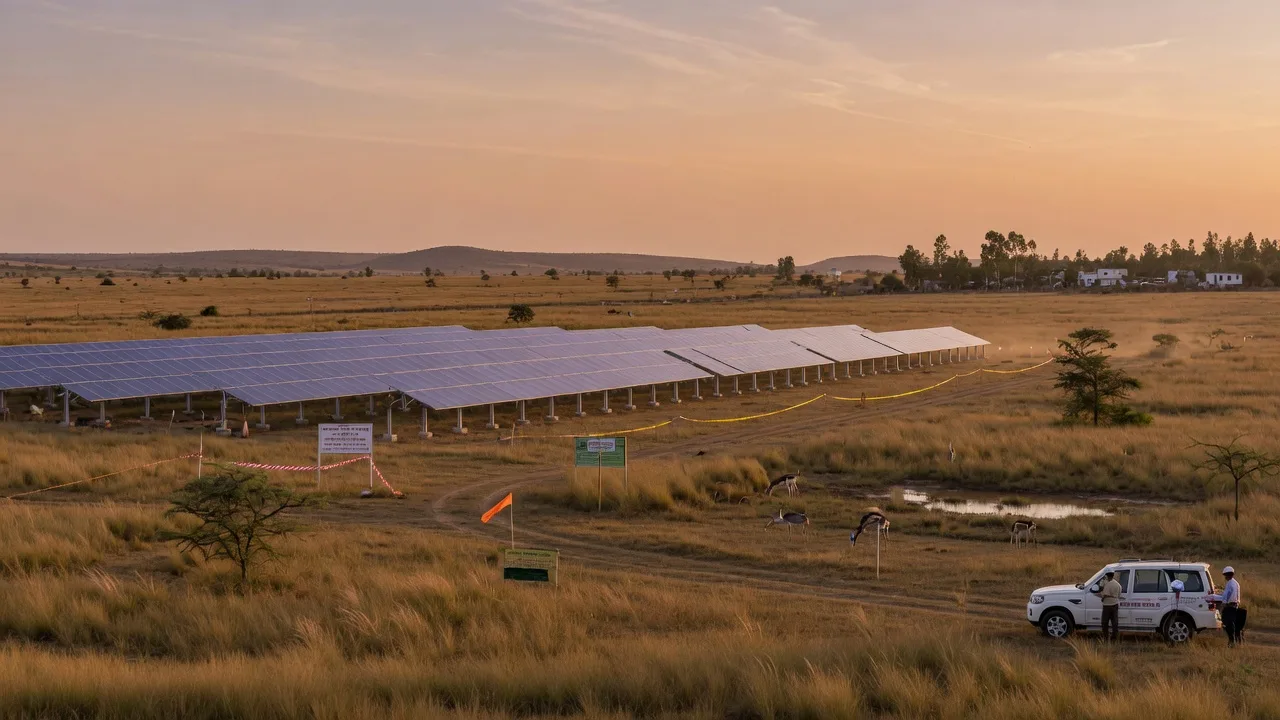
India's largest grassland, the Banni in Gujarat's Kutch district, is at the center of a new conflict between clean energy and conservation. The state government has proposed a 1,000-megawatt solar park on roughly 5,000 hectares of the Banni. But ecologists and local herders say the project threatens a rare ecosystem and a way of life that has lasted centuries.
The Banni spans about 2,500 square kilometers. It is home to the endangered Indian wolf, the houbara bustard, and the chinkara. It also supports the Maldhari pastoralist communities, who have grazed their buffalo and cattle on the grassland for generations.
A fragile ecosystem under pressure
Scientists argue that the Banni is not barren land. It is a unique, self-sustaining biome. The grassland depends on seasonal flooding from the Rann of Kutch and on the grazing patterns of livestock. Remove the grazing, or cover the land with solar panels, and the whole system could collapse.
"The Banni is a living laboratory of co-evolution between wildlife, plants, and people," said a wildlife biologist familiar with the region. "A solar park of this scale would fragment the habitat. It would block the movement of wolves and other animals."
Pastoralists worry about their own future. The Maldhari rely on the open grassland for dry-season grazing. They already face water shortages and shrinking pasture. Fencing off thousands of hectares for solar panels would cut their herds off from key feeding grounds.
Green energy goals versus ground realities
India has set a target of 500 gigawatts of renewable energy capacity by 2030. Gujarat, with its high solar radiation and vast stretches of land, is a key state for meeting that goal. The state government sees the Banni solar park as a way to generate clean power and attract investment.
But activists and researchers point out that the project was approved without a full environmental impact assessment. They say the government treated the grassland as wasteland, a common legal loophole that allows industrial projects to bypass strict scrutiny.
"The classification of the Banni as 'waste land' is outdated and wrong," said a conservation policy analyst. "It is a high-biodiversity grassland. We need a proper study before any construction begins."
The Gujarat government has not released a detailed plan or a timeline for the project. Officials have said that they will consider environmental concerns, but they have not committed to a review.
Alternatives exist
Some experts suggest that the state could build solar parks on degraded land or on rooftops instead. Kutch has large areas of salt pans and fallow farmland that are less ecologically sensitive. Rooftop solar in cities like Bhuj and Ahmedabad could also absorb part of the capacity target.
"The question is not whether we should build solar farms," said the biologist. "It is where we build them. Putting a solar park in the Banni is like putting a wind farm in a bird sanctuary. It misses the point."
The Banni grassland has already lost area to encroachment, invasive species, and saltwater ingress. A large solar park would add another layer of stress. For now, the project remains on paper. But the debate over how to balance India's renewable energy push with the protection of its last wild grasslands is just beginning.
Comments
Be the first to comment.
Leave a comment