
India’s EV Drive: Policy Push, Rising Sales, and Persistent Hurdles
Government schemes and state-level incentives are speeding up electric vehicle adoption, but high costs and charging gaps remain big barriers.
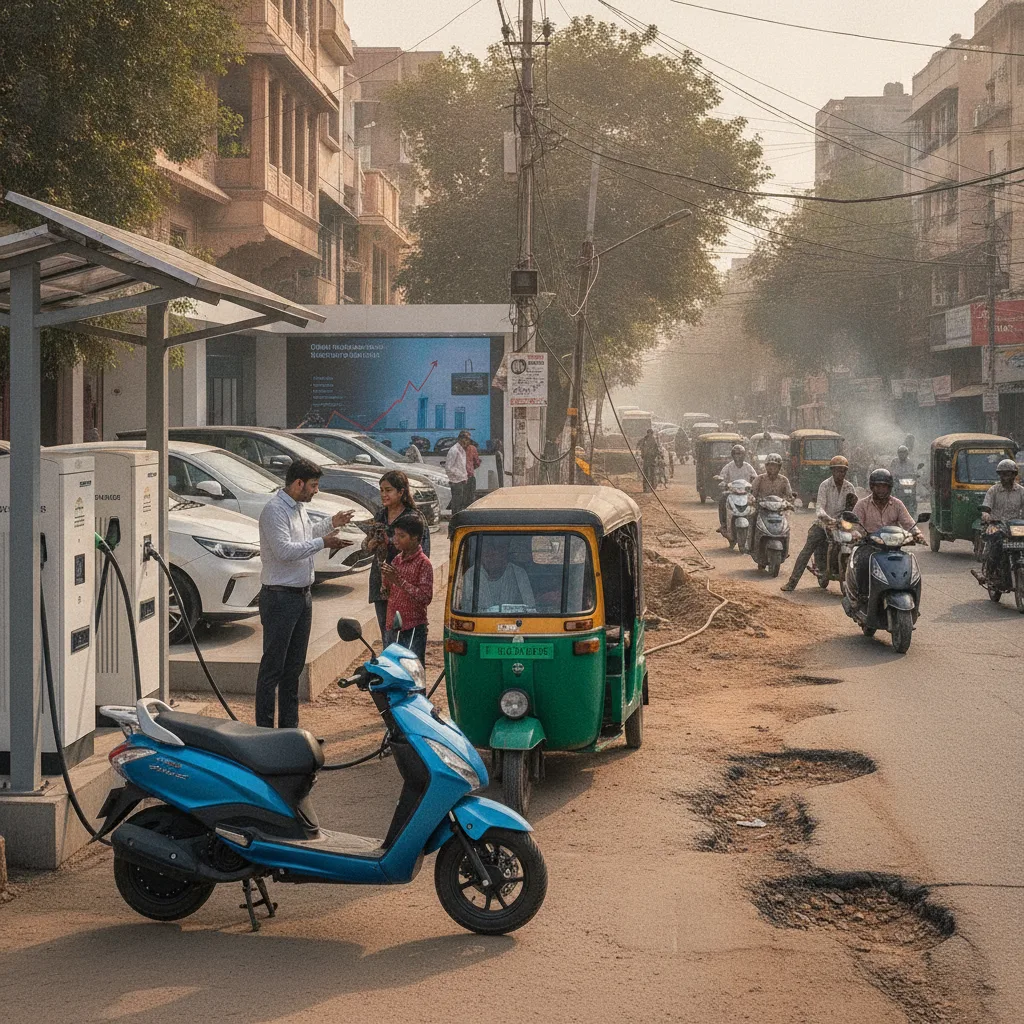
India is pushing hard to shift from petrol and diesel cars to electric vehicles. The government has rolled out several schemes to speed this change. Yet the road ahead is not smooth.
What the government is doing
The central government launched the Faster Adoption and Manufacturing of Hybrid and Electric Vehicles scheme, known as FAME, in 2015. The second phase, FAME II, started in 2019 with a budget of ₹10,000 crore. It gives buyers a direct discount on electric two-wheelers, three-wheelers, buses, and four-wheelers used for public transport.
In 2024, the government replaced FAME II with the Electric Mobility Promotion Scheme (EMPS). This scheme runs for four months from April to July 2024 and sets aside ₹500 crore. It covers only electric two-wheelers and three-wheelers.
States are not waiting for Delhi. More than 20 states have their own EV policies. They offer extra subsidies, road tax exemptions, and registration fee waivers. Some states, like Delhi, Maharashtra, Gujarat, and Tamil Nadu, are leading the pack.
Numbers are climbing
Sales of electric vehicles in India are rising fast. In 2023, EV sales crossed 1.5 million units, a jump of over 50% from the year before. Electric two-wheelers make up the bulk of these sales. Electric three-wheelers, used as auto-rickshaws and cargo carriers, are also doing well. Electric cars still lag, but their share is growing.
The government wants 30% of new vehicle sales to be electric by 2030. That target looks ambitious. But with current growth rates, experts say it is within reach, if the hurdles are cleared.
Why EVs are good for India
Electric vehicles cut down on air pollution. Indian cities are among the most polluted in the world. Transport is a big source of that pollution. Switching to EVs can bring down levels of nitrogen oxides and particulate matter.
EVs also reduce India's oil import bill. India buys most of its crude oil from other countries. That costs billions of dollars every year. More EVs on the road means less money spent on imported fuel.
On the consumer side, running an EV is cheaper than running a petrol or diesel car. Electricity costs less than fuel. Maintenance is also lower because EVs have fewer moving parts.
The big challenges
Price remains the biggest barrier. Electric cars cost a lot more than their petrol versions, often ₹2-5 lakh more. Even with subsidies, the upfront cost puts off many buyers.
Charging infrastructure is another weak spot. India has about 12,000 public charging stations. That is far too few for a country of 1.4 billion people. Most charging points are in big cities. Rural areas and highways have very few. Range anxiety, the fear of running out of battery, is real for many drivers.
Battery technology is still evolving. Lithium-ion batteries are the standard, but they are expensive and their raw materials are not mined in India. The country depends on imports from China, Japan, and South Korea. That creates supply chain risks.
Recycling used batteries is another issue. India does not have a strong battery recycling system. Old batteries can leak toxic chemicals if not handled properly.
What comes next
The government is trying to fix some of these problems. The Production Linked Incentive (PLI) scheme for advanced chemistry cell batteries offers ₹18,100 crore to companies that set up battery plants in India. This is meant to cut import dependence and bring down battery costs.
Private companies are also stepping in. Tata Motors leads the electric car market. Ola Electric and Ather Energy dominate the two-wheeler space. Many startups are building charging networks. But the pace of change is still slow.
India's EV story is one of progress mixed with problems. The policy push is real. Sales are growing. But until prices drop and charging points spread across the country, the shift will stay uneven.
Comments
Be the first to comment.
Leave a comment