
India’s Oil Shock Problem: Why EVs Are the Answer
As global oil prices rattle India's economy, a new analysis argues that electric vehicles offer the clearest path to cutting import dependence and stabilizing the nation's energy costs.
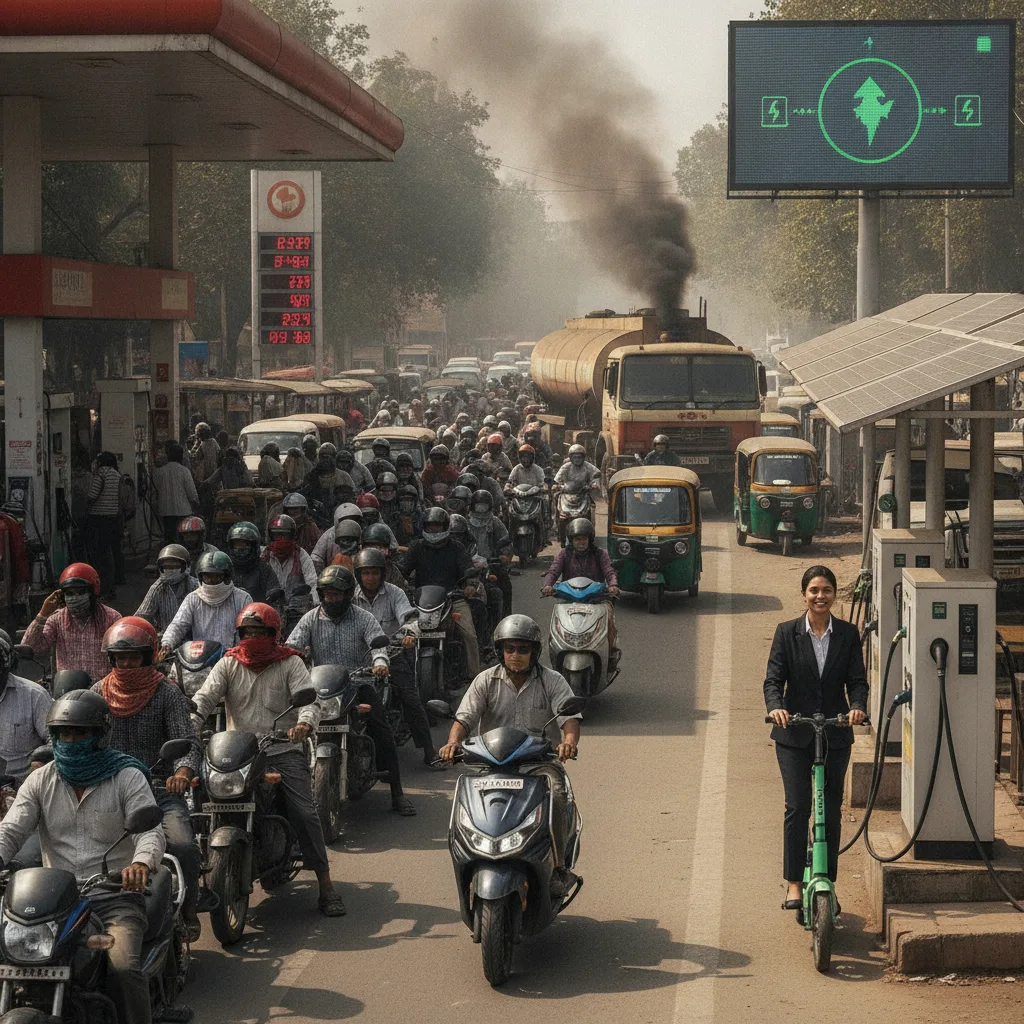
NEW DELHI, Every time oil prices spike, India feels the pain. The country imports more than 80% of its crude oil, leaving its economy exposed to every geopolitical tremor and OPEC decision. Now, a fresh analysis from ET Auto makes the case that electric vehicles are not just a climate fix, they are an economic shield.
The report lands at a moment when global crude prices have been swinging wildly. For India, the world's third-largest oil consumer, each dollar rise in the price of a barrel adds roughly ₹13,000 crore to the annual import bill. That money flows out of the country, widening the trade deficit and pushing up inflation at the pump.
"India's oil shock problem is structural," the analysis states. "It cannot be solved by tweaking taxes or finding new suppliers. It requires a shift in how the country powers its mobility."
Electric vehicles, the report argues, break that link. A battery-powered car or bus runs on electricity generated from domestic coal, solar, wind, or hydro. Even if that electricity comes partly from imported coal, the cost exposure is far smaller than relying entirely on imported crude. More importantly, as India builds out its renewable capacity, the government has set a target of 500 gigawatts of non-fossil fuel capacity by 2030, the electricity used to charge EVs will get cleaner and cheaper over time.
Transport accounts for about 12% of India's total oil demand, and that share is growing as more people buy cars and trucks. The ET Auto report notes that if India can electrify even a quarter of its new vehicle sales by 2030, it could save roughly $14 billion a year in oil imports. Those savings would go straight back into the domestic economy.
The analysis also points to the two-wheeler and three-wheeler segments as low-hanging fruit. India sells more than 20 million two-wheelers each year, and most trips are short enough for current battery ranges. Swapping petrol scooters for electric ones would cut oil use fast, since two-wheelers account for a big chunk of gasoline consumption.
But the report does not sugarcoat the challenges. Electric vehicles still cost more upfront than petrol or diesel models, though battery prices have fallen sharply, down nearly 90% over the past decade. Charging infrastructure remains thin outside major cities, and many consumers worry about range anxiety. The government has tried to address these issues with the Faster Adoption and Manufacturing of Electric Vehicles (FAME) scheme, which offers subsidies. Yet the analysis says the pace of adoption needs to pick up if India wants to blunt the next oil shock.
Other countries have moved faster. China now accounts for more than half of global EV sales, and its domestic battery supply chain gives it a huge cost advantage. Norway has already phased out new petrol car sales. India, by contrast, is still in the early stages: EVs made up only about 5% of total vehicle sales in 2023, though that number is rising.
The ET Auto report calls for a broader push, not just subsidies, but also mandates for commercial fleets, faster rollout of public charging stations, and lower taxes on EV components. It also highlights the role of battery swapping for three-wheelers and buses, which can cut downtime and reduce the need for expensive fast chargers.
For a country that spends more than $100 billion a year on oil imports, the stakes are high. Every rupee spent on foreign crude is a rupee that cannot be spent on roads, schools, or hospitals. Electric vehicles, the analysis concludes, offer a way to keep that money inside India, and make the economy less vulnerable to the next price spike.
Comments
Be the first to comment.
Leave a comment