
India's Solar Push Hits a Wall: Heavy Reliance on Chinese Imports
A new analysis warns that India's ambitious solar energy targets are undercut by a deep dependence on Chinese-made photovoltaic cells and modules.
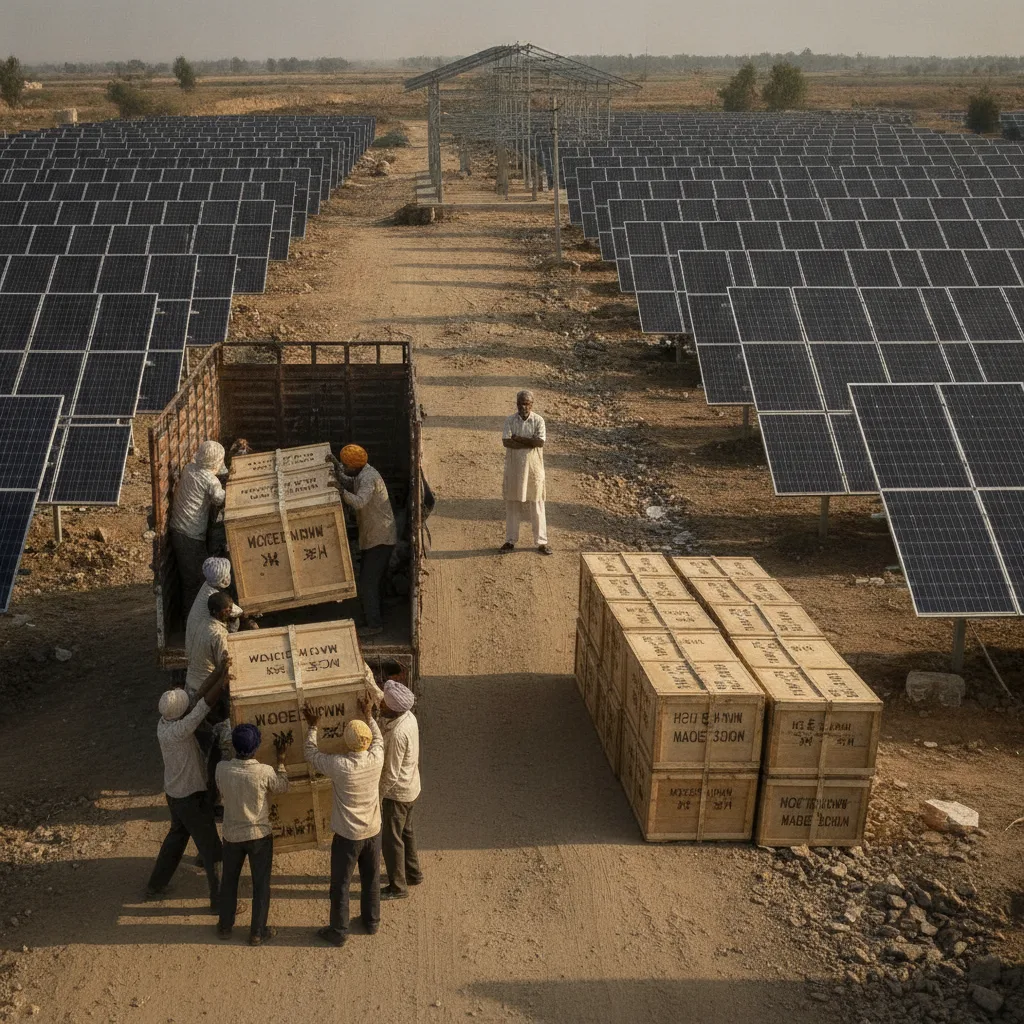
India wants to be a solar superpower. The government has set a target of 500 gigawatts of renewable energy capacity by 2030, with solar doing the heavy lifting. But a recent opinion piece on NDTV points to a big problem: China.
The country now imports nearly 80% of its solar cells and modules from China. That number has climbed sharply over the past five years. Domestic manufacturing has not kept pace. Indian factories can produce modules, but most still rely on Chinese cells, the core component that turns sunlight into electricity.
This creates a risky dependency. Trade tensions between New Delhi and Beijing have flared before. In 2020, the government imposed strict curbs on Chinese investment after border clashes. Yet solar hardware kept flowing in. Why? Because there was no other choice.
Why India Can't Quit Chinese Solar
China dominates the global solar supply chain. It makes over 80% of the world's polysilicon, wafers, cells, and modules. Its factories run at massive scale, driving costs down. Indian manufacturers cannot match those prices without heavy subsidies or tariffs.
The government has tried to fix this. It slapped a 40% basic customs duty on imported solar modules and a 25% duty on cells in 2022. It also launched the Production Linked Incentive (PLI) scheme, offering Rs 24,000 crore to build domestic solar capacity. The idea was to push companies to set up factories inside India.
But results have been mixed. Some firms, like Reliance Industries and Adani Green, have announced big plans. But actual production has been slow to start. Many Indian module makers still import cells because domestic cell production is almost nonexistent. The country has less than 5 GW of annual cell manufacturing capacity. It needs over 30 GW just to meet current demand.
"We are assembling, not manufacturing," says a senior industry analyst who spoke on condition of anonymity. "The real value, the cell, still comes from China."
Policy Gaps and a Long Road Ahead
The NDTV piece argues that India's solar policy has a blind spot. It focuses on module assembly, not the upstream supply chain. Polysilicon refining, ingot pulling, and wafer slicing are capital-intensive and technically hard. China has spent two decades perfecting these processes. India is trying to catch up in a few years.
There is also the question of quality. Some Indian-made modules have underperformed in the field, leading to slower adoption by large developers. Banks and project financiers prefer modules with a proven track record, and that often means Chinese brands.
The government has tried to force the issue. It approved a list of approved module makers, banning non-listed suppliers from government-backed projects. But many of the listed firms still use Chinese cells. The rule has not broken the import habit.
Meanwhile, global solar demand is exploding. Europe and the US are also scrambling to build their own supply chains. That means competition for limited non-Chinese solar equipment will only get fiercer.
India has a choice. It can keep buying cheap Chinese gear and hit its 2030 target faster. Or it can invest heavily in building a real domestic supply chain, and accept slower growth and higher costs in the short term. The NDTV opinion argues that doing nothing is not an option.
"India cannot build a clean energy future on imported parts," the piece states. "That is not energy independence. That is just swapping one import for another."
Comments
Be the first to comment.
Leave a comment